Get Full Government Meeting Transcripts, Videos, & Alerts Forever!
Get email alerts on the Virtual Education topic
No spam. Unsubscribe anytime.
Students, parents and safety advocates urge support for virtual options and operational safety in State Board hearing
Summary
Public commenters at the State Board Accountability Hearings praised Tennessee Virtual Academy for meeting medically fragile and anxious students’ needs and urged continued funding; a school safety accreditation nonprofit asked the board to include operational readiness in accountability measures.
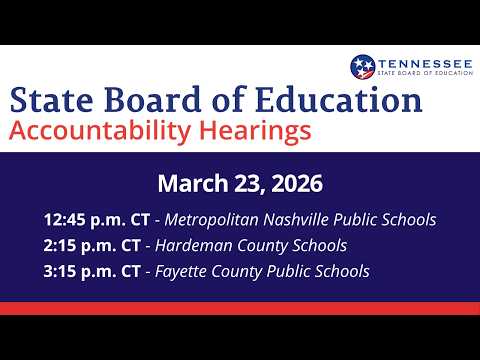
Public testimony at the State Board of Education Accountability Hearings on March 23 focused on two themes: the value of virtual schooling for medically fragile students and a call to broaden accountability to include operational safety.
Fifth-grade student Brannix Wilson told the committee that Tennessee Virtual Academy (TMVA) allowed him to keep learning while managing chronic EBV. “TMVA gives me the flexibility I need to rest when I'm not feeling well while still keeping up with my academics,” Brannix said. His experience, he added, has made school “less stressful and uncomfortable.”
Casey Wilson, an assistant principal at Tennessee Virtual Academy and parent, described virtual education as essential for students with anxiety, medical needs or histories of bullying and urged the board to continue supporting teachers and programs that serve those students. “Virtual education is not a lesser option. It is a necessary option,” Wilson said, adding that her own children benefited academically and emotionally from TMVA’s approach.
Separately, Luke Malstead, president of Security Accreditation Safety Authority (SASSA), a nonprofit focused on K–12 safety and emergency preparedness, told the committee that the state’s accountability framework currently focuses on academic outcomes but does not verify whether schools are operationally safe. “Academic success does not occur in isolation,” Malstead said. He urged the State Board to consider measuring schools’ emergency preparedness and operational readiness alongside academic metrics.
The public-comment portion concluded before the committee moved to district-level hearings. The testimony will be included in the record to inform the committee’s conversations about how accountability, funding and supports intersect with students’ needs and school conditions.