Get Full Government Meeting Transcripts, Videos, & Alerts Forever!
Get email alerts on the Public Safety topic
No spam. Unsubscribe anytime.
El Mirage staff proposes riverbed and wash clearing to reduce encampments; council debates costs and property‑owner agreements
Summary
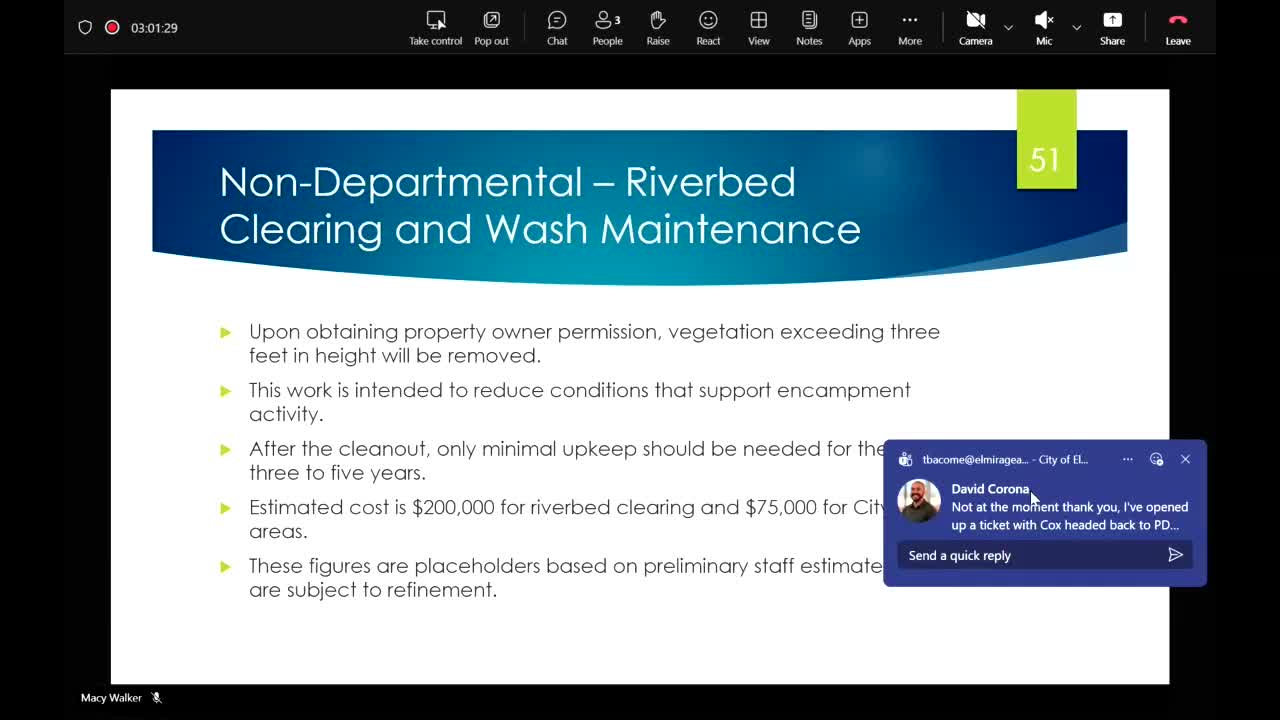
Staff proposed placeholder funding — roughly $200,000 for riverbed clearing and $75,000 for city wash maintenance — to remove tall vegetation that can support encampments; staff said signed agreements with absentee property owners are required and council questioned whether city taxpayers should fund work on privately owned parcels.
City staff proposed a non‑departmental project to remove vegetation in riverbeds and city washes that staff said supports recurrent encampments and public‑safety concerns.
The presentation described preliminary cost placeholders of about $200,000 for riverbed clearing and $75,000 for city wash maintenance. Staff said the riverbed parcels are privately owned in many places and that the city currently has signed agreements only for cleanup of existing encampments; staff recommended expanding those agreements so the city may clear vegetation where property owners grant permission.
Staff framed the work as a public‑safety measure intended to reduce the ability to reestablish encampments and said, if vegetation is removed, minimal upkeep should be needed for three to five years. Council members raised the policy and budget questions: whether private landowners should pay to remove vegetation from their parcels, the complexity of contracting for riverbed work (hazardous waste, nesting seasons, specialized equipment) and the practicality of enforcing liens where owners are not current on taxes.
Staff said much of the privately owned riverbed land has low or negative market value (some parcels were acquired at tax sale) and that property owners frequently do not respond; staff also said they would seek signed agreements to clear vegetation where possible, and that contracting is the likely delivery method for heavy work in sandy riverbeds.
Council did not vote on the proposal during the work session; members asked staff to refine the cost estimates, document property‑owner permissions, and return with options and agreements for council consideration.