Lifetime Citizen Portal Access — AI Briefings, Alerts & Unlimited Follows
Council denies special-use permit for Cosmic Montessori amid traffic and safety concerns
Loading...
Summary
The Katy City Council voted down a special-use permit for Cosmic Montessori Education at 1506 Avenue D after neighbors and the police chief raised safety and traffic concerns; the applicant had proposed a 24-student micro school with a voluntary staggered-dropoff plan and a traffic study showing a 2% peak-hour increase.
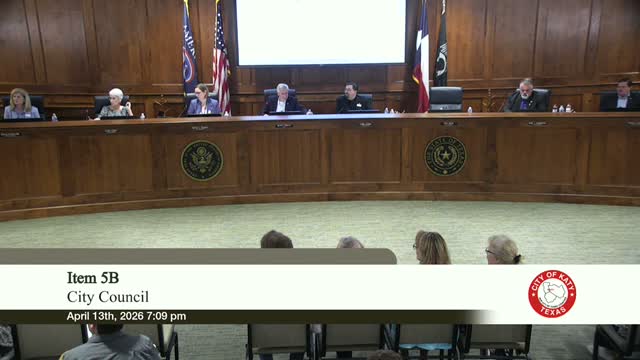
April 13, 2026 — The Katy City Council voted to deny a special‑use permit that would have allowed Cosmic Montessori Education to operate a private elementary micro‑school at 1506 Avenue D.
James Deglard, the applicant, told the council the family‑run school would serve a maximum of 24 students, provide at least six on‑site parking spaces, stagger drop‑off and pick‑up in 15‑minute slots and rely on an agreement for overflow parking nearby. He said the organizers voluntarily commissioned a third‑party traffic impact analysis and that the city’s police department had expressed no operational concerns during informal outreach. “We will be ensuring that we have hedges around the parking lot to make sure that the kids don’t enter into any neighborhood parking lots,” Deglard told the council.
Supporters — including parents who said they want local Montessori continuity for young children — urged approval. “We really had enjoyed the Montessori approach,” Kyla Martin, a parent, said, describing her 5‑year‑old’s experience in Montessori preschool and asking council to approve the local option.
Neighbors and other residents urged denial or relocation. Speakers cited Avenue D’s narrow curve, persistent backups during peak periods, recent near‑misses and broader concerns about converting residential parcels to commercial use. “Avenue D is a nightmare,” one resident said. Several speakers said traffic already backs up from First Street to 10th Street at peak times and questioned whether a small private school would make the situation worse.
The applicant’s traffic engineer, Ash Zamira of Sibotec LLC, summarized the firm’s quantitative analysis and told council the most conservative estimate of trips generated by a full 24‑student micro‑school is 24 vehicle trips; he said the model showed roughly a 2% increase in peak‑hour traffic for Avenue D and a driveway queue storage length sufficient for worst‑case five‑car peaks.
Council discussion focused on location and enforcement. The police chief told the council the department had not been formally consulted and raised concerns about parents arriving early and vehicles stacking on Avenue D. Several council members asked whether school‑zone signage or other mitigations could be required; staff said school‑zone signage could be installed if the school requested it.
Motion and outcome: Council Member Taylor moved to approve the special‑use permit; Mayor Pro Tem Harris seconded. On the roll call the motion failed, 0–4. The council did not adopt the special‑use permit.
Why it matters: The decision highlights tensions between neighborhood safety and small private‑school demand in a growing city where road capacity and timing of infrastructure projects (traffic signal work on nearby streets was discussed, with a 2027–2028 timeframe mentioned) remain top concerns for residents.
What’s next: Because the council denied the special‑use permit, the applicant may revise the proposal, pursue a different site, or return with additional mitigation measures; council did not set a next procedural step during the meeting.