Get Full Government Meeting Transcripts, Videos, & Alerts Forever!
Get email alerts on the Tax Abatement topic
No spam. Unsubscribe anytime.
Community Investment Committee forwards declaratory resolution for Cascade Phase 2 tax abatement
Summary
The Community Investment Committee voted to send Bill 2611 to the full council with a favorable recommendation. Staff said the six-year abatement would support Wharf Partners’ 8-story Phase 2 Cascade project; estimated abated taxes total about $2.7 million over six years.
The Community Investment Committee voted to forward Bill 2611 — a declaratory resolution beginning the process for a six-year real-property tax abatement for Wharf Partners LLC’s Cascade Phase 2 — to the full South Bend Common Council with a favorable recommendation.
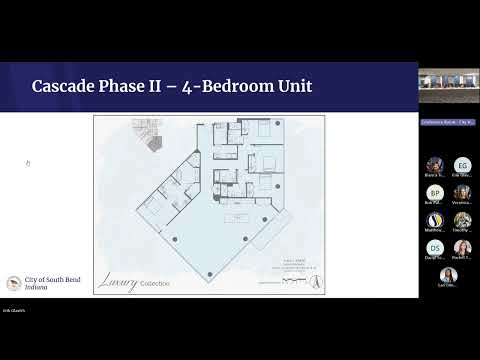
City staff presented the project as an 8-story mixed-use building on the East Bank with about 22–32 residential units and roughly 30,000 square feet of commercial space. Scott Glavish, the city presenter, said the phase-specific abatement would mirror the 2018 abatement for Cascade Phase 1 but be a new, separate incentive for this phase. “This is a transformative project,” Glavish said, arguing the abatement helps make the investment feasible.
Staff’s tax-modeling showed the commercial portion could generate more than $300,000 per year in property tax revenue once built; over six years the city estimated roughly $2.7 million in taxes would be abated under the scenario presented. Glavish explained residential units would receive abatements only while owned by the developer and that abatements would end if units are sold to third parties. The city used an assumption that the developer would hold about 10 units for an average of three years to produce its residential-abatement estimate.
Thomas Panzica, a Wharf Partners member, told the committee the developer had accommodated city projects in the past and that rising construction costs make incentives necessary to deliver the project. “We’ve tried to be good partners with the city,” Panzica said, noting earlier agreements to allow staging and parking during other public projects.
No members of the public spoke during the hearing. After discussion about jobs, wages and timing, a motion to send the declaratory resolution to the full council with a favorable recommendation passed on a roll-call vote reported as 4–0 in committee. The city noted a confirming resolution and final vote on the abatement will return at a later meeting as the second formal step in the process.