Legal aid leaders ask for $80 million-plus to restore eviction, health and access-to-justice programs
Loading...
Summary
Representatives of the Legal Aid Association, community legal aid groups and the Access to Justice Commission urged the subcommittee to fund $50M for the Equal Access Fund, $20M for homelessness-prevention legal services and $10M to protect health-care access, citing high return on investment and dwindling IOLTA revenues.
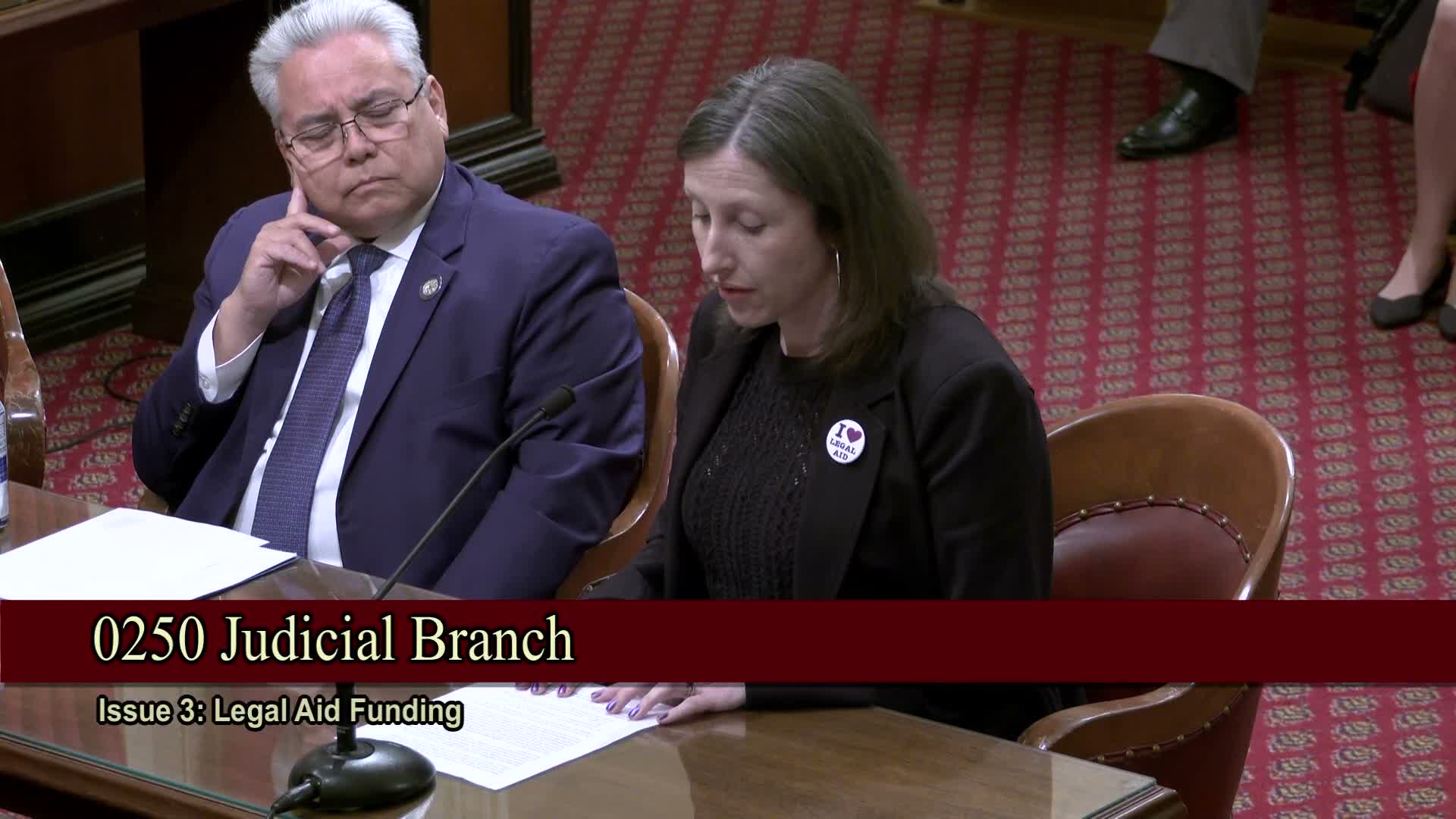
Lauren Klein, director of advocacy for the Legal Aid Association of California, told the subcommittee the state faces rising civil legal needs and urged three investments: a one-time $50 million to the Equal Access Fund, $20 million to restart homelessness prevention legal services, and $10 million to protect access to health care.
Klein said the Equal Access Fund historically helps people keep housing and access benefits; she cited the Federal Legal Services Corporation’s review that "legal aid returns $7 for every $1 invested," and urged lawmakers to consider the long-term fiscal benefits of funding prevention. She explained the $50 million request was in part meant to offset a projected $50 million drop in IOLTA (Interest on Lawyer Trust Accounts) revenue over two years.
Panelists from Los Angeles and Inland counties described how eviction diversion pilots and targeted homelessness-prevention funding stabilized clients. Judge Sergio Tapia (Presiding Judge, Los Angeles Superior Court) described an LA Court dashboard showing hotspots and the county’s eviction-diversion pilot in Compton and at the Stanley Mosk courthouse. Kate Maher (Community Legal Aid SoCal) and Tessie Solarzano (Inland Counties Legal Services) gave examples in which early legal intervention prevented homelessness and recovered benefits and rent arrears for clients.
Klein and Solarzano also outlined additional Access to Justice Commission asks: legal-aid loan repayment assistance to retain new attorneys, preauthorization supports tied to AB 495 (Family Preparedness Act) for caregiver arrangements, and $5 million in innovation and infrastructure grants. They said many nonprofit legal aid groups are losing federal funds and that the requested state investments would restore services that previously helped nearly 200,000 Californians and recovered tens of millions in client funds.
Committee members asked for more detail about how requested dollars would be distributed by formula and asked the presenters to provide written materials and maps of services by senate district for follow-up. The subcommittee did not take immediate action.