State public defender asks Legislature to make Racial Justice Act positions permanent as workload spikes
Loading...
Summary
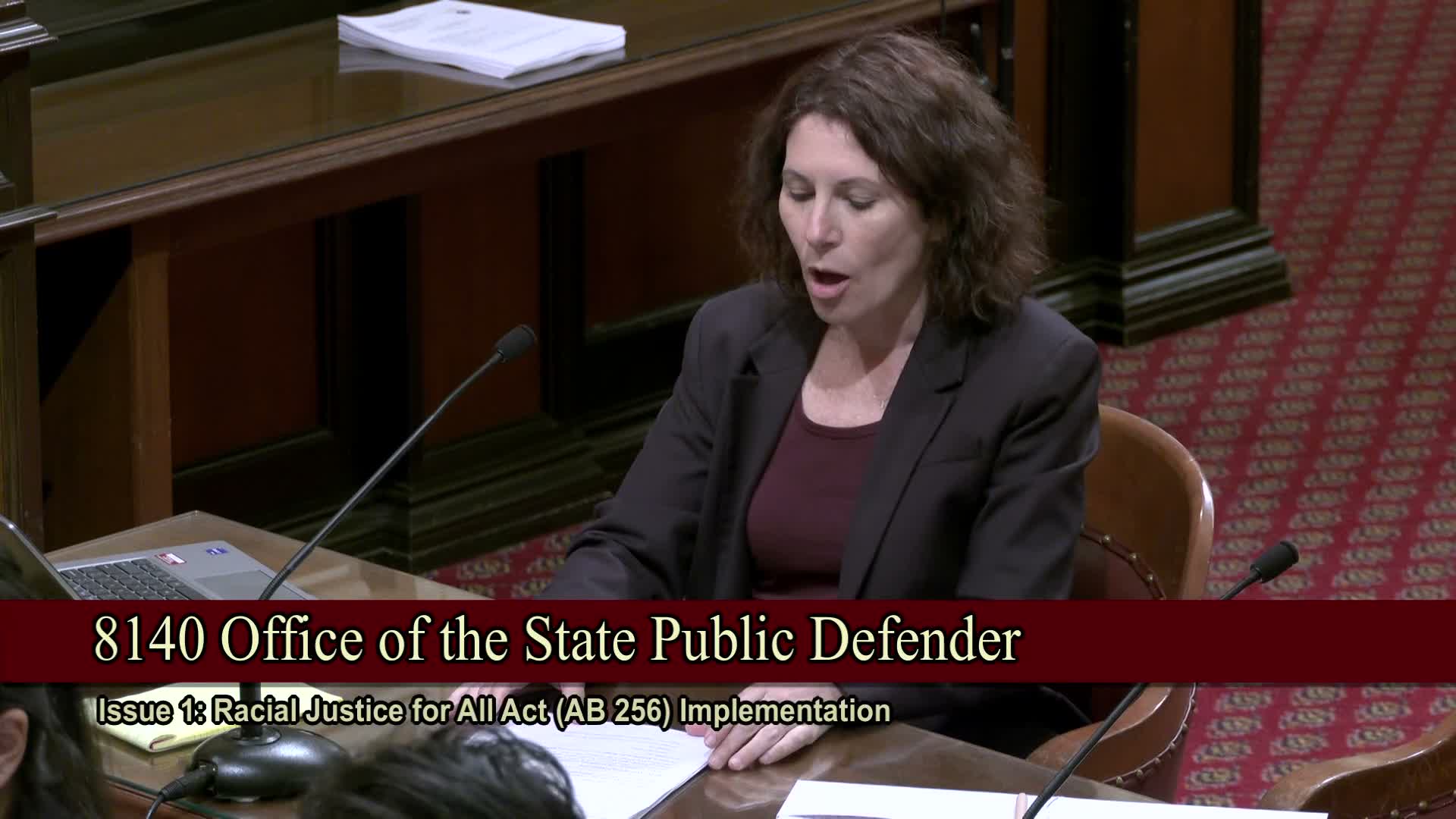
Galit Lipa, California state public defender, told the Senate Budget Subcommittee the Office of the State Public Defender needs permanent staff to handle retroactive Racial Justice Act (RJA) claims, citing tens of thousands of pages of records and an estimated 11,000 additional staff hours per year.
Galit Lipa, the state public defender, told the Senate Budget Subcommittee No. 5 that recent changes implementing the Racial Justice Act require permanent staffing to meet ongoing capital appellate work.
"OSPD is requesting to make permanent positions necessary to implement the Racial Justice Act," Lipa said, adding that the temporary funding provided in 2023 expires this June. She said the work is not new but "ongoing," and without attorneys to bring RJA claims "no relief can be had."
Lipa described the magnitude of the work: after the California Supreme Court began ordering full RJA briefing in late 2023, previously inactive cases had to be restaffed, requiring review of "tens of thousands of pages" and briefs that "can go up to 200 pages in the capital context." She told senators the RJA workload is "adding over 11,000 hours of additional work a year to our staff." The office has requested four attorneys, a research data specialist for statistical analysis of RJA claims, and a staff service analyst to handle CPRA and administrative data tasks.
Senator María Durazo pressed Lipa on a spike in CPRA requests and what that volume indicates; Lipa said most recent CPRA demand comes from incarcerated individuals seeking sentencing and race data and that producing such records is time-consuming because of legal constraints on electronic data and communication with incarcerated requesters.
The presentation also tied RJA implementation to appellate practice: Lipa explained that capital trials are tried in superior court but appealed directly to the California Supreme Court, which began ordering supplemental RJA briefing and, in 2024, required some RJA claims to proceed as writs of habeas corpus — a change that adds evidentiary hearings, investigations and experts to OSPD’s workload.
Lipa referenced the broader AB 625 workload study in the same hearing, saying the report shows county-level trial defense systems and statewide appellate work are strained; the study documented investigator and support-staff shortages and recommended state involvement through funding and standards.
The committee did not vote on funding; senators asked OSPD to provide additional documentation and data after the hearing. The subcommittee will consider budget language and statutory requests as part of the larger budget process.