Get AI Briefings, Transcripts & Alerts on Local & National Government Meetings — Forever.
Board adopts 2025 Utility Master Plan; Oilville extension deemed cost‑prohibitive at ~$114M
Loading...
Summary
The board adopted the Department of Public Utilities' 2025 Utility Master Plan, which forecasts storage and capacity needs through 2050, includes projects to raise storage to ~2.5M gallons by 2030, and reports an Oilville water/sewer extension estimate of about $114 million judged cost‑prohibitive.
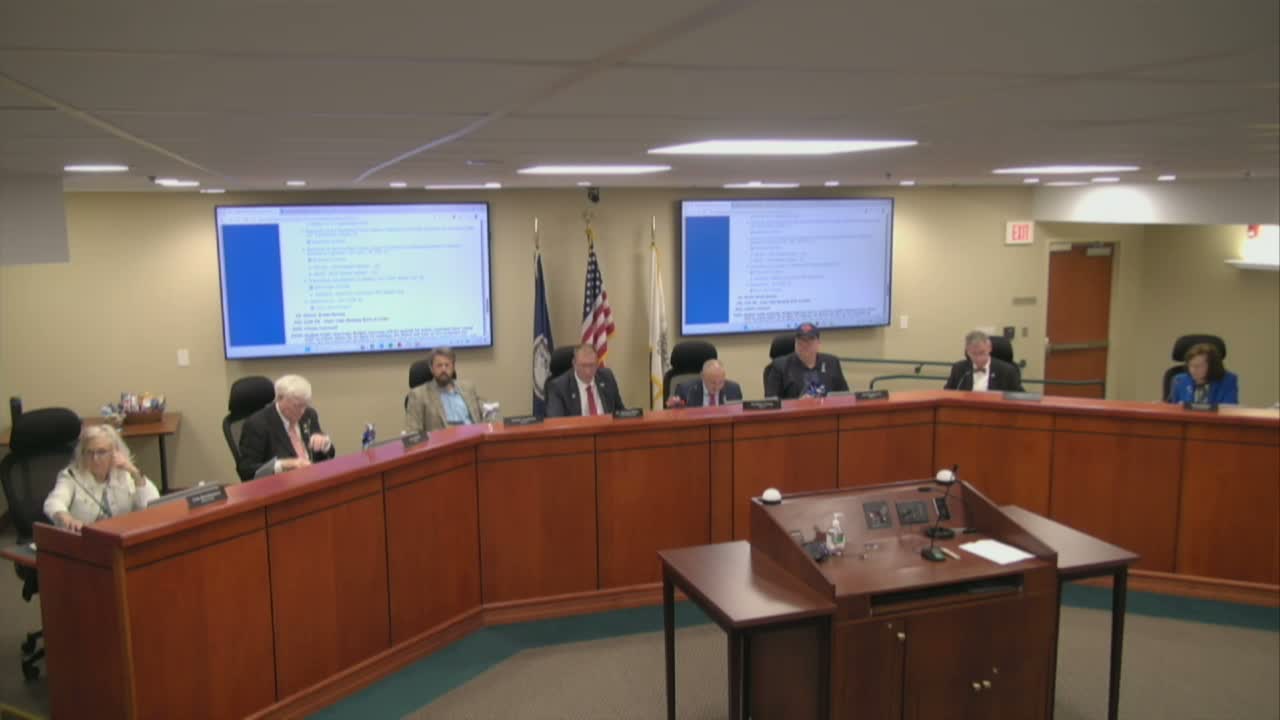
The Goochland County Board of Supervisors adopted the updated 2025 Utility Master Plan on April 7 after a detailed presentation by Director of Public Utilities Elizabeth McDonald.
McDonald told the board the plan models water and wastewater infrastructure needs for the courthouse and eastern systems through 2050, using a conservative assumption that designated growth areas could be fully developed within the planning period. Key takeaways include planned storage and pressure projects that would provide roughly 2.5 million gallons of storage by 2030 and 5.5 million gallons by 2050, and identified pump station improvements and force‑main work to address projected wastewater capacity concerns.
On Oilville the master plan included a feasibility study funded by the Economic Development Authority. McDonald said the only viable technical route was to extend utilities from the Eastern End, but that the estimated cost—approximately $114,000,000—made the project cost‑prohibitive for the county at this time. "The cost of extending utilities from the Eastern End to the Oilville area still comes at a cost of $114,000,000 which the Department of Public Utilities recommends as a cost‑prohibitive amount," McDonald told the board.
The plan also recommends near‑term administrative and operational improvements including an in‑house rehabilitation program, new superintendent roles for field and mechanical repairs, improved asset management usage through the Beehive work‑order system, cross‑training for operator licensure and a customer portal launch this summer to provide billing and usage transparency.
Costs presented were class‑5 estimates (‑50% to +100% accuracy range) and McDonald emphasized they are intentionally conservative. The board adopted the plan after questions from supervisors about pump‑station timing, water pressure zones and the potential to use James River source water in a longer‑term context.
What happens next: staff will include several identified projects in the FY27 CIP and continue financial planning via a utility financial modeling tool (Water Worth) to assess rate scenarios and fiscal impacts of CIP timing.