Get Full Government Meeting Transcripts, Videos, & Alerts Forever!
Get email alerts on the Environment Bosque topic
No spam. Unsubscribe anytime.
Bosque volunteers outline monitoring, trash removal and invasive-species work
Summary
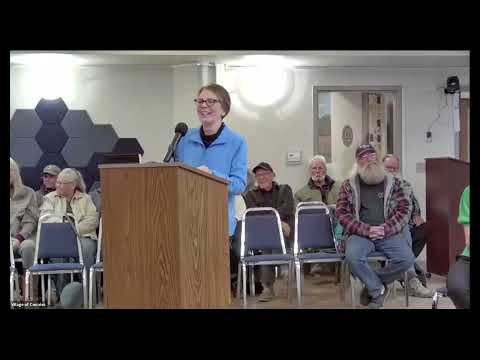
Joan Hashimoto, chair of the Bosque Advisory Commission, told the Corrales governing body that volunteers and partners carried out monthly monitoring, removed fallen wood and trash, restocked eight dog‑bag stations (about 8,500 bags last year) and will participate in U.S. Army Corps-sponsored ecological monitoring.
Joan Hashimoto, chair of the Bosque Advisory Commission, told the Village of Corrales governing body that volunteers divide the Bosque into seven monitoring sections and check them monthly for fallen limbs, litter and other hazards. “We divvy up the Bosque into 7 sections and monitor them monthly for fallen tree limbs, litter, dog poop, and the unusual,” Hashimoto said, noting the commission’s reliance on volunteers and cooperation with village departments.
Hashimoto credited Roadrunner Waste with regular free pickups for collected trash and said Sandoval County has allowed green‑waste disposal at no charge. She described coordinated wood‑removal events with the fire department and public works, and said a January wood‑removal used a tractor with a grapple attachment. “We did have our first wood removal of the year, and we thank Chief Martinez for his event coordination,” Hashimoto said.
The commission recently replaced a weather‑damaged wildlife mural and installed UV‑protected covering at the Cabazon channel, installed dog‑bag stations at eight Bosque entrances and recorded total bag usage of about 8,500 last year. Hashimoto urged residents to report downed trees to the fire department dispatch line instead of cutting them themselves, both for safety and to preserve inspection standards.
Hashimoto also described a new monitoring partnership: the U.S. Army Corps of Engineers has expressed interest in sponsoring two sites in the south Bosque willow swales for multi‑year monitoring under the Bosque Ecosystem Monitoring Program (BEMP). “The program will be for 4 years, and BEMP has about 2 dozen sites along the river,” she said, adding that monitoring will include groundwater depth, vegetation, water chemistry, cottonwood health, tamarisk and leaf beetle observations.
Councilors and residents asked about signage and trail connectivity. Hashimoto and staff said east‑facing street signs will be placed primarily at Bosque crossings and parking points to help people identify locations for emergency reporting; they also recommended the what3words app as an additional, precise location tool. On a proposed state North‑South Trail, Hashimoto said planning is in early stages and highlighted barriers including gaps in continuous trail alignment and fences on reservation land that would require routing work.
Hashimoto summarized volunteer needs and upcoming work: more coordinated dead‑and‑down wood removals, a Ravenna grass seed‑head removal event planned for early fall, and potential cottonwood pole planting in Cabazon pending materials. She closed by inviting council members to a Bosque tour when weather permits.
The presentation identified specific partnerships (Roadrunner Waste, Sandoval County, the U.S. Army Corps and UNM scientists) and flagged safety, invasive‑species control and continued volunteer recruitment as priorities for the coming year.