Small‑business programs and arts payroll fund show strong demand; OSBA details outcomes
Loading...
Summary
OSBA deputies told the subcommittee California RISE grantees increased revenue and hired thousands, and the Performing Arts Equitable Payroll Fund disbursed $11.6M to 100 recipients but left roughly $40M in unmet requests. Senators and program partners pressed for implementation changes and additional funding.
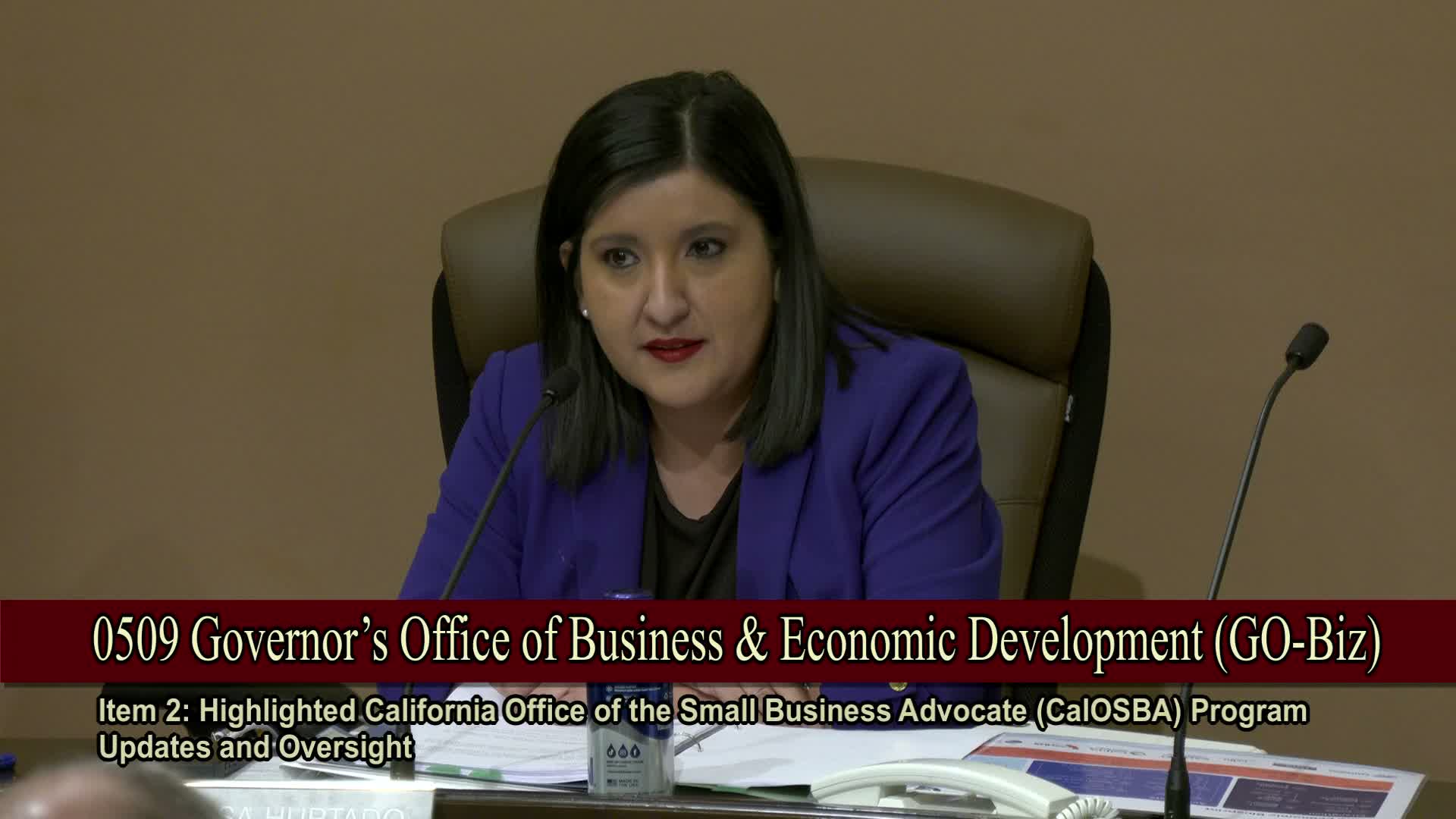
Claire Whitmer, deputy director of the California Office of the Small Business Advocate, summarized outcomes and next steps for three OSBA programs before the Senate subcommittee.
On California RISE, Whitmer said the inaugural cohort used a $25,000,000 appropriation and deployed $16,900,000 in grants to 61 recipients (grant sizes ranged from $150,000 to $500,000 by revenue bands). 'In 4 years from 02/2021 to 2025, these 61 grant recipients collectively employed 14,301 individuals with barriers to employment,' she said, adding that 3,887 of those hires were new during the program period. Whitmer described version 2 (CA RISE 2) with $17,000,000 in funding, a maximum grant size of $300,000 for new grantees, continuing services for the original cohort, an incubator lane, and an RFP for a third‑party administrator that closes April 23.
Julie Baker, CEO of California for the Arts and the program administrator for the Performing Arts Equitable Payroll Fund (presenting by Zoom), said the inaugural round distributed $11.6M in payroll reimbursements to 100 organizations, with awards from $11,471 to $296,295 and an average award of roughly $124,000. Baker said the fund’s structure produced no fraud cases and a low ineligibility rate (11%), but demand far outstripped supply: 'close to $40,000,000 in requests remains unfunded,' she said, and estimated more than 8,000 potential jobs remained unsupported.
OSBA and partners proposed three statute and implementation fixes to improve the next round: narrow reimbursable costs to gross wages only, simplify the 'primary mission' test (for example, a 60% expenses threshold for performing arts mission), and allow shorter reimbursement periods (two quarters versus a full year) to stretch limited funds.
On technical assistance (TAP) and capital infusion (SIP), Whitmer reported seven program years of cumulative reach (more than 853,000 businesses supported historically) and metrics for the most recent year: 112,016 unique businesses served, including 3,788 new business starts; $54.7M in loans landed; and $432M in equity capital raised. Whitmer said the TAP/SIP network helps businesses access federal drawdown and leverages federal matching funds.
Why it matters: the OSBA programs aim at job creation and small‑business resiliency, with direct impacts on underserved communities. The performing arts fund is positioned as a sector stabilization tool after AB 5 triggered reclassification of contract workers; program administrators recommended statutory clarifications to accelerate future rounds and allocate funds more efficiently.
What’s next: OSBA expects to execute CA RISE 2 grant agreements and open a grant portal this summer; administrators said they will follow up with the subcommittee with additional evaluations, metrics and a proposed set of statutory changes for the performing arts fund.