Get Full Government Meeting Transcripts, Videos, & Alerts Forever!
Get email alerts on the School Performance topic
No spam. Unsubscribe anytime.
State board committee urges corrective action for Coopertown Middle after hearing on turnover, EL and culture
Summary
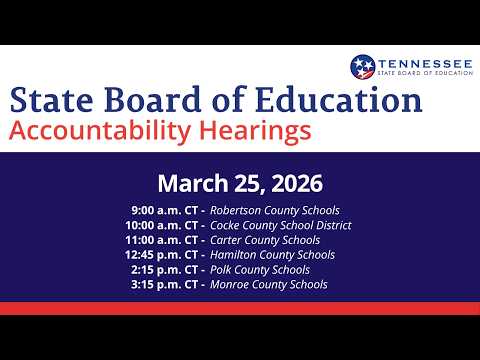
The State Board of Education accountability committee recommended a corrective action plan for Coopertown Middle (Robertson County) after district leaders described high principal turnover, large incoming EL and SPED populations and steps to strengthen Tier 1 instruction, coaching and behavior supports.
Daryl Cobbins, chair of the State Board of Education accountability committee, opened the hearing by saying the process is intended to be constructive, not punitive. Robertson County officials told the panel Coopertown Middle has struggled with leadership instability and staffing churn — "we've had three new principals over the last three years," district assistant director Melanie Dickerson said — and that the 2024–25 school year saw unusually large numbers of vacancies filled at the school.
District staff highlighted targeted supports now in place: an EL academic coach who meets weekly with Coopertown teachers, two full‑time academic coaches assigned to the building, a behavioral instructional liaison, and a middle‑school coordinator providing frequent planning and "train‑the‑trainer" support. Dr. Kathy Beck, the district turnaround consultant, said she is working on site three days a week to lead PLCs, model instruction and produce weekly reports for the district team: "We have three big focuses at Coopertown Middle: good delivery of second language strategies, weekly data review, and student goal setting," she said.
Committee members pressed officials on teacher recruitment and retention. The district described a Grow Your Own program expected to place district employees on certification pathways and a differentiated pay experiment aimed at rewarding growth. Cobb County officials noted the school’s high concentrations of English learners and special education students and recommended sustaining frequent classroom monitoring and leadership support.
After deliberation the committee voted, without objection, to recommend a corrective action plan to the State Board of Education. Chair Cobbins stressed the step is intended to codify and monitor the district’s existing strategies in concert with the Department of Education rather than to punish the school.