Get Full Government Meeting Transcripts, Videos, & Alerts Forever!
Get email alerts on the Property Tax Roll topic
No spam. Unsubscribe anytime.
Preliminary Austin property tax roll shows 3.1% decline; appeals reduce FY2025 roll by roughly $1.8B
Summary
City staff told the Audit & Finance Committee that TCAD's preliminary values project a 3.1% decline in taxable values, with new construction estimated at $2.8 billion and a high volume of appeals lowering the FY2025 roll by about $1.8 billion compared with last July, complicating revenue forecasts under the state's 3.5% cap.
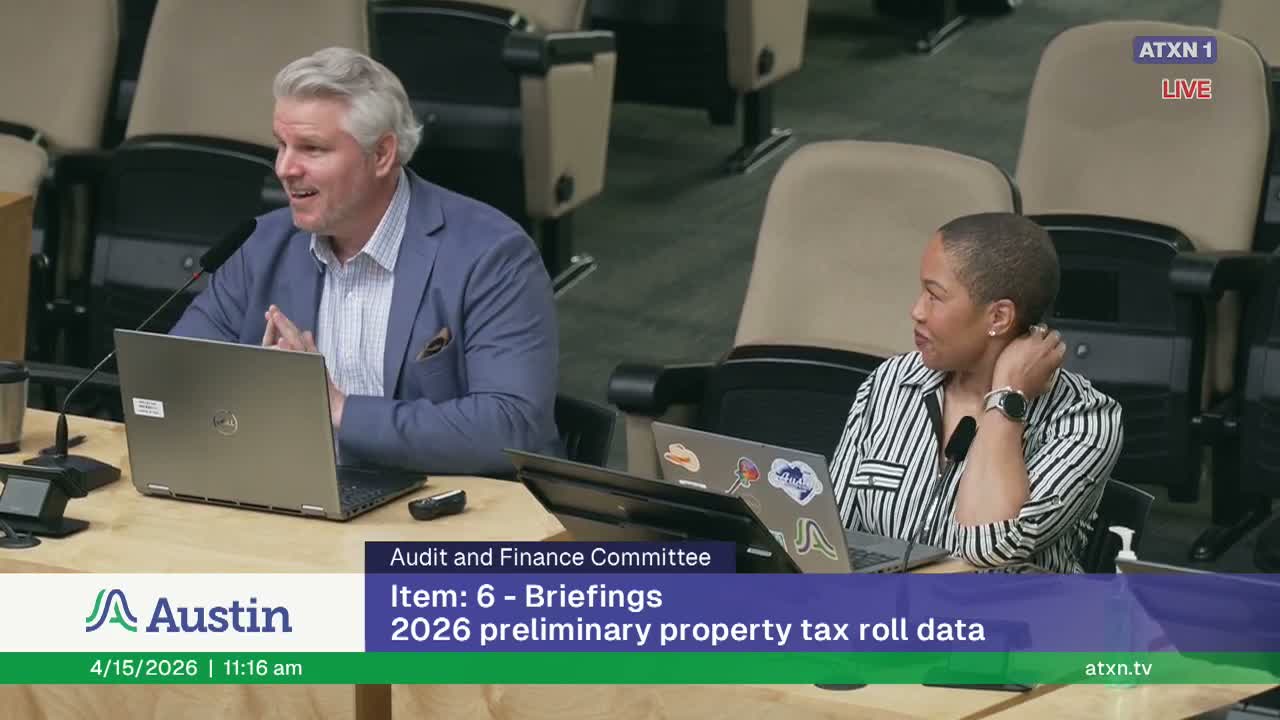
Eric Nelson, deputy director of Budget and Organizational Excellence, presented a first look at the preliminary property tax roll for tax year 2026 and the implications for fiscal 2027 revenue forecasting.
Nelson said Travis Central Appraisal District (TCAD) projects a net decline in taxable values of roughly 3.1% compared with last summer's certified roll. He noted projected new construction of about $2.8 billion for the year—roughly $500 million less than the previous year and about $300 million below earlier projections—which reduces the portion of revenue not subject to the 3.5% state revenue cap. Nelson also reported that a high volume of tax appeals has pushed the FY2025 roll down by approximately $1.8 billion versus the certified July roll, creating added uncertainty for near‑term collections and the five‑year forecast.
Council members asked clarifying questions about how the 3.5% cap is calculated and implications of the business personal property exemption expansion at the state level. Nelson said the city will not have final certified numbers until late July and that appeals can move hundreds of millions of dollars in valuation as decisions are resolved, making forecasting challenging.
Staff indicated a forecast packet will be provided to council and the public ahead of the full‑council work session where staff will present more detailed projections and the requested forecast "cone of uncertainty."