Lifetime Citizen Portal Access — AI Briefings, Alerts & Unlimited Follows
Utilities board approves application for $4.9M lead-service-line replacement project; two resolutions passed
Loading...
Summary
The Bloomington Utilities Board approved submission of an Indiana Finance Authority SRF funding application for a $4.9 million project to replace deteriorating mains and lead service lines, including seeking up to $1 million in principal forgiveness; the board passed two resolutions authorizing submission and acceptance of the preliminary engineering report.
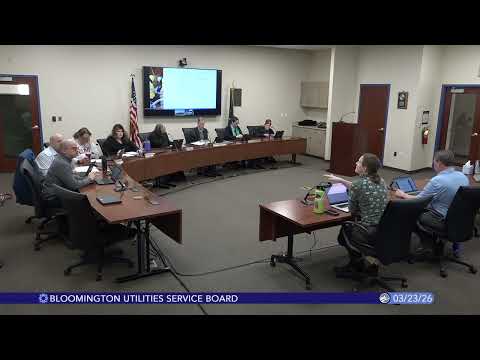
The Bloomington Utilities Board on March 23 approved staff’s request to submit an Indiana Finance Authority (IFA) State Revolving Fund application to replace lead service lines and deteriorating mains across the city’s water system.
Consultants from Arcadis and City Utilities staff said the project’s estimated construction cost is $4.9 million and that up to $1 million of that total could be provided as principal forgiveness (a loan portion that would be forgiven once the project is complete) if the application is selected. The presenters said much of the proposed work is in areas the IFA considers disadvantaged and that the funding package could include additional forgiveness or very low interest loans for the remainder.
Arcadis and CBU staff explained the project is motivated by public-health concerns and federal regulatory changes following Flint, Michigan. Presenters said the EPA’s upcoming lead and copper rule improvements start timing in 2027, including requirements to inventory service-line materials and a 10‑year timeline that will require utilities to replace lead service lines. CBU staff said their inventory includes more than 27,000 service connections and that about 9,600 of those remain “unknown” for material; the project would target several deteriorating main segments and roughly 70 service lines believed to be lead or galvanized.
Board members asked about costs, customer impacts and logistics. Staff said the project would be free to impacted customers only if the funding package covered those replacements; otherwise, the remainder would be funded through water-budget sources identified in the rate case. Staff said the project is expected to be a mix of in‑house City Utilities work and contracted construction, that procurement rules for EPA-funded work require public contracting for construction elements, and that typical SRF loan terms for a city like Bloomington are advertised at low interest rates (presenters cited an example published rate of about 2.38% subject to change at loan closing).
Presenters discussed public outreach and the practical challenge that customers own the portion of the service line on private property and must give permission for replacements; they noted national experience showing multiple contacts may be needed to obtain homeowner agreement. Staff also said they would provide pitcher-filter kits and post-replacement sampling and that CBU added in‑house sample-processing capacity using their ICP mass‑spec instrument to reduce lab outsourcing costs.
Two resolutions related to the application were approved by voice vote: Resolution 2026‑06 (signatory authorization to allow Arcadis to submit materials and to authorize a signatory to accept loan documents if selected) and Resolution 2026‑07 (acceptance of the preliminary engineering report required for the SRF application).
The next steps are public-notice and public-comment opportunities on the preliminary engineering report, final application submission to IFA by April 1, and subsequent review and pre‑closing steps by IFA. If selected, staff said construction could be staged and those portions of the work could be executed within a multi‑year capital program and rate case schedule.