Get Full Government Meeting Transcripts, Videos, & Alerts Forever!
Get email alerts on the Ai And Workforce Policy topic
No spam. Unsubscribe anytime.
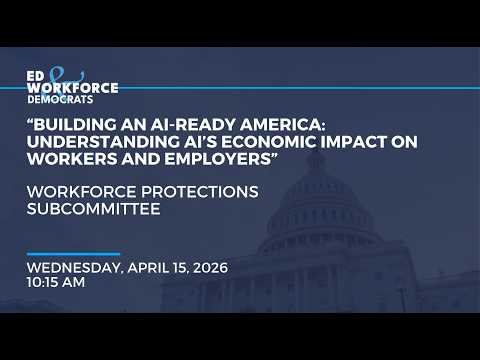
House subcommittee hearing lays bare partisan divide over AI’s workplace risks and benefits
Summary
A House Education and Workforce subcommittee hearing featured competing views: industry and employer representatives urged measured federal standards and warned that a patchwork of state laws will hamper innovation, while labor advocates and Democrats called for stronger worker privacy safeguards, enforcement funding, and new data collection to track AI’s effects.
A House Education and Workforce subcommittee hearing spotlighted competing visions for how Congress should address artificial intelligence in the workplace, with witnesses and members debating whether federal policy should emphasize protecting innovation or safeguarding workers.
Chairman McKenzie opened by saying AI is ‘‘reshaping productivity, decision making, and competitiveness’’ and urged ‘‘policies that strike the right balance between innovation and accountability’’ to support domestic leadership in AI. Ranking Member Omar countered that AI ‘‘has the very real potential to deepen this economic hardship and inequality’’ and pressed for enforceable safeguards and more resources for agencies that protect workers.
Employer-focused witnesses described practical uses of AI. Chatrain Birbal, senior vice president for public policy and government relations at the CHRO Association, said companies use AI to boost productivity, improve accessibility, and support learning and development, and recommended clarifying how existing workplace laws apply rather than creating an ‘‘overly prescriptive’’ new statute. Matthew Gizzo, a shareholder at Ogletree Deakins, told the panel that AI can improve wage-and-hour compliance by aiding classification, timekeeping and payroll calculations.
Labor and worker-advocacy testimony emphasized risks. Sarah Stevens, director of worker power at We Build Progress, warned that AI-powered surveillance ‘‘allows employers to collect and use troves of personal information’’ that can be used to retaliate against union organizers and deepen discrimination. Stevens and Democratic members urged mandatory disclosure of monitoring practices, stronger enforcement of existing labor laws, and increased funding for the Department of Labor and the National Labor Relations Board.
Witnesses also pressed for better data. Rachel Gessler, a senior research fellow focused on economics and workforce policy, said lawmakers lack reliable information about where AI is used and how it changes tasks and hiring. She recommended expanding Census business surveys and directing the Bureau of Labor Statistics to develop a task-based database to inform future policy.
On the partisan edge, several Democratic members criticized Republicans for holding hearings without producing worker-centered legislation; Republicans and some witnesses warned that overly broad state or federal rules could stifle innovation and harm U.S. competitiveness, especially relative to China.
The hearing proceeded without votes; members were encouraged to submit written follow-ups. The subcommittee left the record open for 14 days for additional statements.