Get Full Government Meeting Transcripts, Videos, & Alerts Forever!
Get email alerts on the Building Codes topic
No spam. Unsubscribe anytime.
Cochise County advisory board reviews proposed 2024 building-code updates, flags deck, vapor-barrier and wind-load issues
Summary
A local building advisory board reviewed proposed local amendments to the 2024 International Building Code, 2023 National Electrical Code and the 2012 energy code, debated permit exemptions for decks and temporary structures, raised concerns about vapor retarders beneath slabs, and voted to continue the meeting to April 30 for further review.
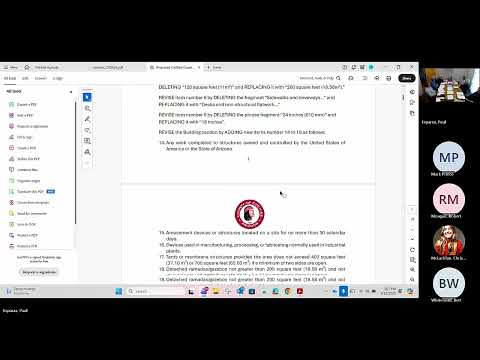
Members of the Building Accounting Advisory Board met to review proposed local amendments to the 2024 International Building Code (IBC), the 2023 National Electrical Code (NEC) and the 2012 International Energy Conservation Code (IECC). Staff presented a package of changes drawn from a joint Tucson–Pima committee and prior local amendments and invited discussion and edits before formal adoption.
Staff member (Presenter) said the packet reflected two years of review and inspector input and that staff had attempted to retain local provisions that remain applicable while incorporating joint‑committee recommendations. "We went through each of the individual codes," the presenter said, "and we had an opportunity to look at those proposed code amendments to figure out what would be applicable for Cochise County." The presenter also noted staff would hold a separate home‑builders briefing so stakeholders would not be blindsided by changes.
Why it matters: the proposed amendments change local permitting thresholds and technical requirements that affect contractors, homeowners and county reviewers. Committee members emphasized they did not want to adopt language that would unintentionally exempt hazardous work from permitting or create construction practices that cause damage over time.
Key debates and decisions
Permit exemptions and decks: Staff proposed a clarified list of small projects that could proceed without a building permit. The draft exempts certain flat, nonstructural work under 200 square feet and items less than 30 inches above grade, but many members objected to using the word "decks" in the exemption language. One committee member recommended striking "decks" and replacing it with a definition such as "nonstructural flat work," arguing an elevated deck above 30 inches or a large multi‑level deck still requires permitting and safety features like railings. Staff agreed to remove or reword the reference and add clarifying thresholds for when a permit is required.
Pools and state law: The presenter noted the state statute defines a swimming pool threshold at 18 inches rather than the prior 24 inches; members supported aligning the local amendment with the ARS language. The transcript cites the statutory cross‑reference as "ARS 36 16 8 1."
Vapor retarders and slabs: Builders raised concerns about a proposed requirement for vapor retarders directly under slabs. A contractor said several local projects that placed a plastic vapor retarder directly beneath the slab experienced pronounced curling and cracking, and urged the committee to either require placement under the compacted base or allow a registered design professional to specify vapor control based on soils. "I would have no problem requiring it under all slabs, but I would require it under the base," one builder said; another recounted a slab that cracked end to end after a vapor retarder was placed directly under the concrete. Staff agreed to flag the item for revision and add a footnote or design‑professional exception.
Electrical, grounding and service sizing: The draft contains exemptions and conductor sizing language drawn from the NEC and joint committee edits. Members debated requiring Ufer (concrete) grounding versus ground rods for different scenarios and questioned a proposed prescriptive requirement that ungrounded conductors be not less than a 200‑amp rating in some dwellings. Participants asked staff to revisit wording on conductor sizing and to add exceptions where service configurations or provider rules make a prescriptive requirement impractical.
Wind loading and local design values: Staff proposed new uplift and wind‑resistance language (including attention to microburst effects) from the joint committee but said Cochise County would retain a local design wind speed of 115 mph rather than accept a lower value that appears in the new national tables. Members also flagged a likely typographical error showing identical values for Risk Category 3 and 4; staff will correct the table.
Administrative and procedural items: Staff proposed longer permit application and expiration windows in some categories (moving some review timelines toward 365 days). The committee clarified that floodplain and other specialty permits are separate from building permit timelines and asked staff to route corner‑lot or FEMA floodplain cases to the county floodplain division for additional review.
Formal actions and next steps
The committee approved the previous meeting minutes by voice vote without recorded dissent. Near the meeting end, members moved, seconded and approved a motion to continue the discussion and reconvene on April 30 so the residential sections and remaining pages could be reviewed in more detail. Staff said it would send a follow‑up meeting notice and will update the draft language to incorporate the committee’s asterisks and technical questions before the next meeting.
Attribution and sources
Quotes come from meeting participants as recorded in the committee transcript, including named officials who identified themselves (Sharon Pulsar, engineering representative; Greg Ploem, architect; Jim Hargrave, Cochise County building inspector) and multiple committee members who spoke during the review. Legal references and code citations discussed at the meeting were recorded verbatim from the transcript (for example, a statutory citation given as "ARS 36 16 8 1").
What comes next: Staff will return updated language on deck exemptions, vapor‑retarder placement, conductor sizing and wind‑speed tables and will circulate a notice for the continued meeting on April 30.