Niagara Falls school staff present $211.26 million budget that would use reserves and hold tax levy flat
Loading...
Summary
District staff presented a proposed $211,260,990 2024–25 budget that would hold the tax levy at $25,828,989, rely on about $8 million in reserves and $2 million in attrition savings, and proceed to a public hearing May 7 and voter referendum May 19.
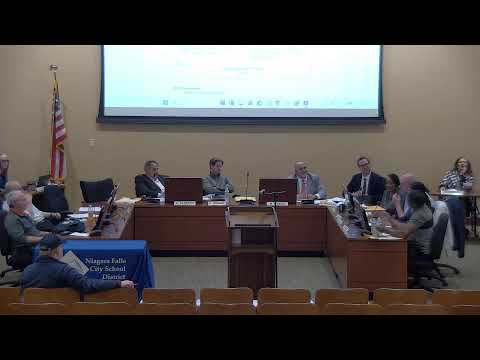
At the Niagara Falls City School District work session on April 16, board leaders and finance staff presented a proposed $211,260,990 budget for 2024–25 that would keep the district’s tax levy unchanged and draw on one-time reserves and attrition to close a revenue shortfall.
Chair outlined four "levers" the district can use when balancing a budget and said the administration recommends a combination of reserve use and staffing reductions through attrition rather than a tax increase. "We are not recommending any tax levy increase," the Chair said, and staff confirmed the levy would remain at $25,828,989.
The finance presenter stated the budget total that will appear in the resolution is $211,260,990. Staff told the board the plan depends on roughly $2,000,000 in reductions achieved through retirements and attrition combined with about $8,000,000 from reserve funds. The presenter also noted that foundation-aid growth is modest (about $3,900,000, roughly a 2.75% increase) and is largely offset by rising costs such as health insurance increases of about 12% for active employees and 15% for retirees.
Officials warned that a delayed state budget and flat federal Title I funding (the district currently receives about $5,100,000 annually) increase uncertainty. "What that doesn't account for is that in the last 3 or 4 years, nothing, no expenditure has stayed completely flat," the Chair said, urging the board to monitor finances closely.
Staff walked the board through fund balances and projected that the district’s unassigned fund balance would decline from 4% to about 3.17% if the proposed plan is adopted. The presenter said staff plan to use specific restricted reserves (workers' comp, ERS, TRS and a terminal-leave pot) and noted certain reserve draws are necessary (for example, debt-service reserve funds must be spent down as part of capital projects).
Officials laid out the calendar for public review and approval: the property tax report card must be mailed April 24, a public hearing on the budget will be held May 7, and the districtwide budget vote is scheduled for May 19 (polls 11 a.m.–8 p.m.). Staff reminded the board that because the district stayed within the tax cap, the budget needs a simple majority (more than 50%) to pass; if it fails, the district would be required to operate under a contingency budget that would eliminate certain purchases and charge for facility use.
The presentation also summarized a recent three‑year audit of American Rescue Plan (ESSER/ARP) expenditures that produced four procedural findings. The district disputed three of the four findings and said none involved misuse of funds: the findings related to the naming of federal funds on timesheets, a small procurement threshold overage when purchasing supplies for nonpublic schools during the pandemic, separate inventory lists kept in different locations, and a procedural mismatch for how some nonpublic reimbursements were handled. "No student was hurt. Nobody took money," the Chair said in response to the audit summary.
The board voted to enter executive session to discuss nine pending and potential child-victim litigation cases; chair said no action would follow the private session.
The board is expected to consider the budget adoption resolution at its next meeting and move the proposal to the May 19 voter referendum.