Get Full Government Meeting Transcripts, Videos, & Alerts Forever!
Get email alerts on the Book Challenge topic
No spam. Unsubscribe anytime.
Parents and residents clash at Nassau County School Board over library books and review process
Summary
At an Oct. 24 Nassau County School Board meeting, parents and residents debated challenges to multiple library titles. A filer said four books violate Florida obscenity law and House Bill 1069; the district attorney confirmed those titles were removed during the review process. The meeting featured opposing testimony on parental rights, free access and district policies.
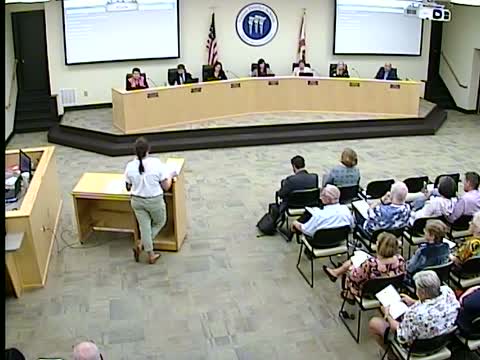
Ginger Brinkley, who filed a formal materials objection, urged the Nassau County School Board on Oct. 24 to remove four school-library titles she said contain "graphic ****** content" that violates Florida statute chapter 847 and to enforce House Bill 1069 (2023). "These books contain graphic ****** content that directly violates Florida statute chapter 847," Brinkley told the board during the public-comment portion of the meeting.
Brinkley asked the board to form a community review committee, require committee decisions within 30 days of an objection, and start notifying parents when students check out books with mature themes. She cited HB 1069 —s language and said the law requires removal when a passage cannot be read aloud at a public school board meeting.
The board's attorney clarified the district's formal objection process and the interim handling of challenged items. "The 4 titles that you have filed an objection from have been removed and are required to be removed through the entirety of the process," he said, describing a committee review, an appeal to the superintendent and a final appeal route to the board and, ultimately, to a special magistrate appointed by the governor.
The issue prompted broad public comment on both sides. Supporters of removal raised statutory and safety concerns, linking some passages to grooming risks and potential criminal exposure for the district if materials were available to minors. Opponents said removal undermines access, warned of politicizing libraries and urged parents to use the district's parental-permission mechanisms.
Christian Stocks, speaking for his mother, said books "can be a mirror or a window" and stressed context and the instructional value of some challenged titles. "Books offer a nuanced understanding of complex topics," Stocks said. Other speakers, including authors of public letters and parents, described both the harms and the educational value they had found in specific works.
Several commenters pressed the board for clarity about books that had been returned to shelves following litigation. Richard Lampkin said he believed the district's prior decision to return certain titles had removed age restrictions; the district attorney responded that the public record attached to the lawsuit lists age or grade restrictions (for example: middle school, high school, adult or parental consent) for returned titles.
Superintendent Dr. Burns acknowledged the sensitivity of the subject and asked the public to recognize the district's work: "We are an academically high achieving district," she said, noting staffing and compliance pressures caused by recent state legislation.
What happens next: the district's formal objection and review procedures remain the primary avenue for resolving challenges; the attorney noted that the removal of titles during a pending objection is required by state law. The board did not take an additional, immediate formal vote on broader policy changes at this meeting.
(Reporting note: direct quotes and procedural descriptions come from the public-comment and legal-process explanations provided at the Oct. 24 meeting.)