Lifetime Citizen Portal Access — AI Briefings, Alerts & Unlimited Follows
Attorneys clash over whether APA's 30‑day review deadline overrides 3‑year pension rule in Dana Rush appeal
Loading...
Summary
At oral argument in Dana Rush v. State of Washington, appellants' counsel argued the Administrative Procedure Act provides the exclusive route to challenge agency determinations denying supplemental retirement benefits; opposing counsel said Supreme Court precedent fixes a three‑year accrual rule that prevents collapsing that limit into a 30‑day deadline.
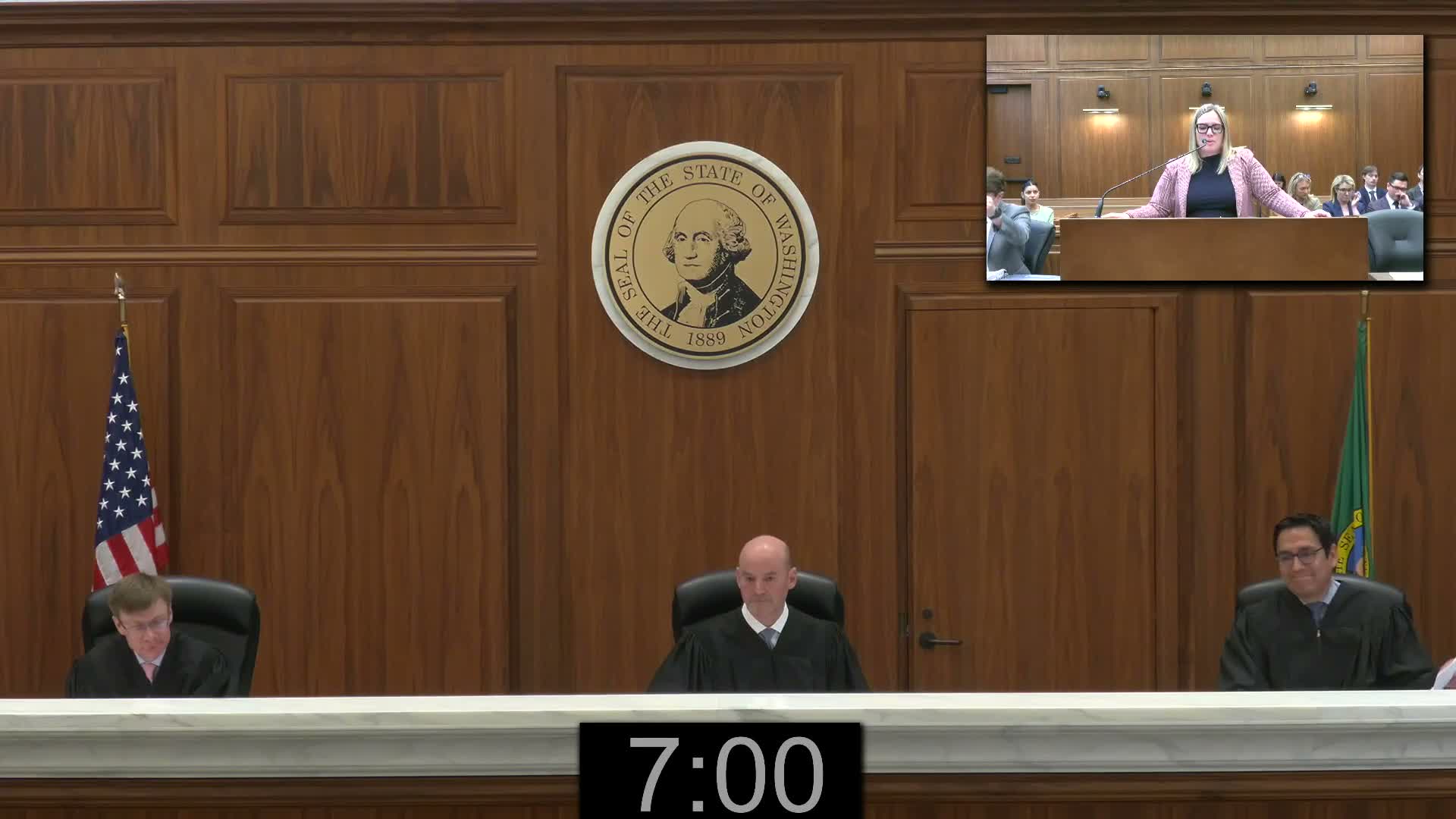
Attorney Chelsea Maim told the court that the Administrative Procedure Act provides the exclusive method for judicial review of agency actions and that decisions to grant or deny benefits fall squarely within that definition. "The APA makes clear that it provides the exclusive means for judicial review of agency actions," she said, arguing the agency's email denying supplemental retirement benefits constituted a final agency action that should be reviewed under the APA.
Opposing counsel Alex Strong, representing a certified class of community college instructors, urged the court to affirm the trial court's exercise of original jurisdiction and to follow Supreme Court precedent holding that impairment‑of‑pension claims accrue at retirement and are subject to a three‑year statute of limitations. Strong said the line of cases treating pension impairment claims as subject to a three‑year window meant the plaintiffs' suits were timely filed within that period.
A senior Questioner pressed both sides on whether the two rules can be harmonized. The Questioner noted that Supreme Court decisions have repeatedly held that a pension impairment claim "accrues when the person retires," meaning plaintiffs have three years from retirement to sue, and asked how applying the APA's 30‑day petition‑for‑review deadline to agency actions would avoid collapsing the three‑year rule into a shorter period.
Maim replied that the Freedom Foundation decision and the text of the APA allow reading a statute of limitations and procedural review deadlines in harmony; she said respondents sought benefits from the agency, were denied in a final agency action, and declined to use the APA's judicial‑review procedures. She also argued the APA's procedures exist to ensure consistency and efficiency in administrative decisionmaking.
Strong countered that many Supreme Court cases have addressed similar pension claims, and he asserted that those precedents support treating pension impairment claims as governed by the three‑year accrual rule rather than a 30‑day deadline tied to an agency notice. He framed the plaintiffs' filings as original actions asking the court to adjudicate contract‑like pension disputes and to remand for damages where liability has been established.
The parties debated whether earlier cases reached merits because the state had not argued the APA as a jurisdictional bar; they cited cases including Bowles, Hester, Olds v. DRS, Fowler, and NOAA in a dispute over whether the APA displaces traditional superior‑court remedies for contract‑like pension claims. Counsel acknowledged that if the legislature itself had altered the pension plan, the three‑year statute would plainly apply, but they disagreed about the consequence when the contested change or the agency determinations are presented as agency actions.
No decision was announced at the conclusion of the argument. The court recessed after thanking counsel; the transcript records the argument only and does not include any ruling.