Get Full Government Meeting Transcripts, Videos, & Alerts Forever!
Get email alerts on the Corporate Negligence topic
No spam. Unsubscribe anytime.
Appellate panel hears dispute over whether contracted anesthesia group can face corporate-negligence liability
Summary
At oral argument in Joshua Brothers v. Or in Bellevue LLC, appellants asked the court to reverse three summary-judgment orders, arguing a contracted anesthesia group (Matrix) owed corporate duties beyond vicarious liability; respondents urged the court to affirm, saying precedent limits corporate negligence to entities providing direct patient care.
An appellate panel heard argument in Joshua Brothers v. Or in Bellevue LLC on whether an anesthesia-provider group that contracts with facilities can be liable under the corporate-negligence doctrine or whether its liability collapses into ordinary vicarious liability.
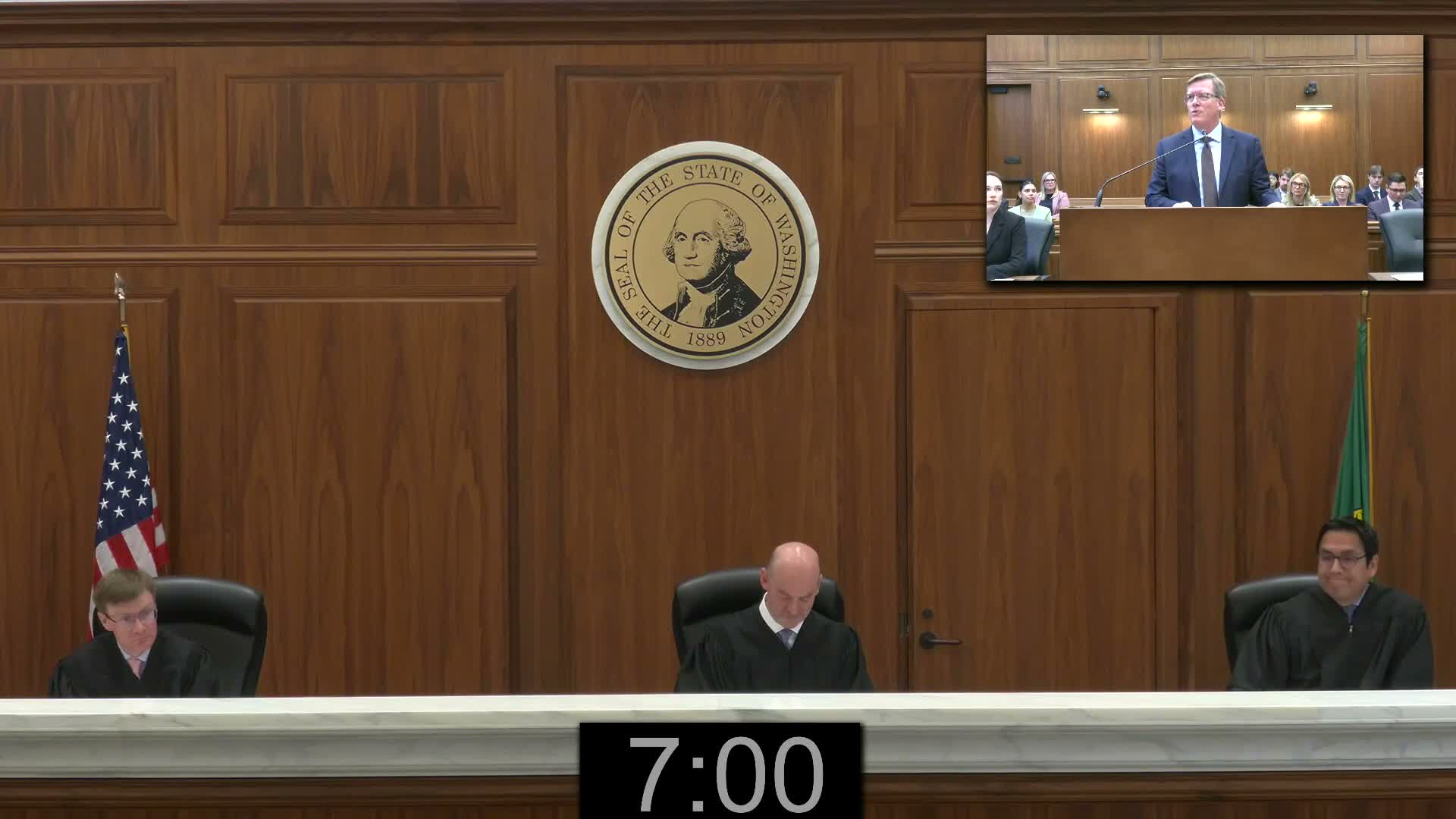
George Aaron, counsel for the appellants, told the court the panel should reverse three summary-judgment orders and hold there are factual disputes about corporate negligence and medical battery claims. He also said the collateral-source modification in RCW 7.70.080 raises constitutional questions the court should consider. "We're asking the court to reverse 3 summary judgment orders and hold there are questions of fact regarding corporate negligence and medical battery claims," Aaron said at the outset of argument.
The dispute centers on whether the statutory and common-law duties that support a corporate-negligence claim extend beyond hospitals and facility operators to entities such as Matrix, a physician-group contractor that supplies anesthesiologists to multiple facilities. Aaron pointed to the medical-malpractice statute (RCW 7.70.040) and argued its definition of "health care provider" is broad enough to include Matrix and that Matrix's contractual commitments (including to address anesthesia-related complications) create enterprise-level duties. He identified multiple components that plaintiffs say support a corporate duty: failure to perform risk assessments for prophylactic antibiotics, failure to evaluate magnitude of harm where a patient had a penicillin allergy, failures to mitigate hazards (including ensuring alternatives and readiness to treat allergic reactions), and absence of Matrix-specific policies, procedures or mechanisms to ensure consent forms were completed.
Respondents, represented by Amanda Thorzbig, urged the court to affirm the trial court's dismissal. Thorzbig said precedent distinguishes entities that provide direct patient care (facilities that supply rooms, equipment, staff and policies) from contractor groups that supply clinicians and defer to facilities' policies and training. "Matrix doesn't even have a facility where patient care is provided," she said, arguing many of the criticisms leveled by plaintiffs (transfer protocols, drill logs, facility policies) apply to the facility rather than to Matrix. She also relied on LaPlante and related authority to contend that, where an individual physician has the duty of informed consent and vicarious liability exists, a separate corporate-negligence claim may be duplicative.
The court pressed both sides on the factual contours that would make the difference. One panel member asked whether the statute's "any entity" language plainly sweeps in groups like Matrix and whether, if Matrix fits the statutory definition, any resulting liability would merely affect apportionment of fault at the allocation phase rather than create a separate legal duty. The bench also probed whether Matrix's contractual promises (cited in the record as CP1003) to provide services in an operating room and to remain responsible for anesthesia-related complications mean Matrix voluntarily assumed more than a staffing role.
Thorzbig pointed to case law (including precedent described during argument as Pedrosa, Douglas v. Freeman, Carson v. Ashbaugh, and Howell) to emphasize limits on imposing corporate duties and to argue that informed-consent obligations are individualized and generally belong to the treating physician, not the corporate employer. Aaron replied that corporate-negligence doctrine — as reflected in jury instructions and cases where courts sustained claims for failures to provide adequate assistance or policies — can apply when an entity's conduct and contractual structure create unreasonable risks and when the entity is in a better position than the individual clinician to prevent harm.
The exchange focused on legal doctrine and on what factual record would be necessary at trial to support a corporate duty distinct from vicarious liability. Aaron stressed the plaintiffs' experts had identified gaps specific to Matrix (for example, the absence of a Matrix policy ensuring ORM consent or fertility-clinic consent forms were signed and no separate Matrix forms or mechanisms existed to guarantee signatures). Thorzbig countered that the experts had improperly lumped the facility and Matrix together and that, under the facts presented, the trial court correctly concluded plaintiffs had failed to identify a legally cognizable corporate duty.
The court did not announce a decision from the bench. The argument concluded after both sides summarized their positions and the panel indicated it would take the issues under submission. The appeal concerns whether summary judgment should have been reversed to allow factual development on corporate-negligence theories and whether statutory and constitutional arguments about the collateral-source modification merit review.
The court thanked counsel and took the matter under advisement; no vote or ruling was issued at the hearing.