Yamhill County to explore state 'moderate income' revolving loan to spur homeownership
Loading...
Summary
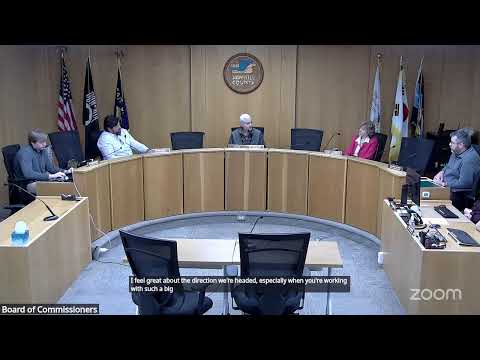
At its April 16 meeting the Yamhill County Board of Commissioners agreed to explore joining Oregon Housing and Community Services' moderate income revolving loan program, a state-funded gap-financing tool designed to support homeownership for households at 80–120% of area median income (AMI).
The Yamhill County Board of Commissioners on April 16 gave staff direction to pursue an intergovernmental agreement (IGA) and work with cities to explore participation in Oregon Housing and Community Services' Moderate Income Revolving Loan (MIRL) program, a state-funded pool intended to help develop homeownership and rental projects serving households between 80% and 120% of area median income.
OHCS representative Megan Ellertson told the board the program issues 0% loans to sponsoring jurisdictions and provides gap financing that is recycled back into a revolving fund. "We have 75,000,000 right now in the revolving loan fund," she said, adding that the state issues loans to jurisdictions and can accept either a fee-in-lieu (TIF-like) repayment or alternative pledged revenue as the repayment mechanism.
Commissioner Starett framed the program as targeted support for moderate-income homeownership. "The moderate income revolving loan is aimed at basically boosting homeownership for moderate income Oregonians," Starett said, noting the tool would address the housing niche between 80% and 120% AMI.
Developers and local partners described preliminary project concepts. Austin Turner of Adamson Holdings said the company is eyeing sites in McMinnville and Newberg and estimated typical homeownership projects could need roughly $1.5–$2 million in gap proceeds to make 40–50 homes financially feasible. Turner said the firm would aim to sell units in McMinnville in the $350,000–$370,000 range and keep designs compatible with existing neighborhoods.
Board members and county staff concentrated on implementation details and county workload. Commissioners asked who in county government would administer applications, how administrative fees would be collected and whether the county would face ongoing liability if a loan defaulted. OHCS staff said administrative costs would be calculated per project and that the standard distribution built into their model provides 5% of a project's MIRL funding to the sponsoring jurisdiction and 1% to the county tax office for administration.
The board did not vote on an IGA. Instead, commissioners signaled a consensus to "explore" participation and requested staff continue working with OHCS and interested cities. OHCS reiterated that a city typically adopts a local ordinance to start a MIRL program, the city notifies OHCS, OHCS issues an IGA with the county, and a master agreement with the city follows. Ellertson noted OHCS posts a template ordinance and IGA on its website and offered technical assistance to jurisdictions considering the program.
Next steps: cities that want to move forward are expected to consider local ordinances; if a city pursues an ordinance, the county said it would review proposed project-specific IGAs and bring any formal IGA to the board for action.