Portland school district outlines shift to integrated ELD to keep multilingual learners in core classes
Loading...
Summary
Portland Public Schools told its Teaching, Learning and Enrollment Committee on April 9 that it is moving to an integrated English-language-development model across grades, aiming to keep multilingual learners in grade‑level classes with co-teaching, align credits under House Bill 2056, and invest in a three‑year professional‑development rollout for teachers.
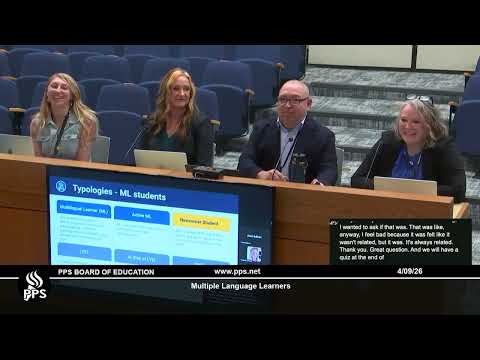
Portland Public Schools presented an expanded plan for multilingual‑learner services to the Board of Education’s Teaching, Learning and Enrollment Committee on April 9, saying the district will emphasize integrated English‑language development (ELD) so students receive language supports inside grade‑level classes rather than being pulled out of instruction.
Senior director Joanna Tobin and director Will Flores told the committee the district serves about 4,100 active multilingual learners — roughly 10% of students — and that roughly half of those students speak Spanish at home. The district’s priorities include ensuring access to rigorous grade‑level content while providing language scaffolds, preventing students from becoming long‑term English learners and helping students exit services by about fifth grade where possible.
Tobin said the district groups multilingual services into four categories: newcomer programs (intensive, short‑term secondary supports), dual‑language immersion (DLI) programs, designated ELD for newer learners, and integrated ELD for students actively receiving services. Flores described integrated ELD as co‑teaching and embedded language objectives in content lessons so students ‘‘stay in the classroom’’ and get academic and language instruction simultaneously.
The presenters tied that approach to legal obligations and precedent, saying meaningful access to both language development and grade‑level instruction is rooted in the Civil Rights Act of 1964, Lau v. Nichols and the Equal Educational Opportunity Act. They argued integrated models reduce the ‘‘othering’’ and missed instruction that can result from pull‑out programs.
The district outlined program counts and patterns: approximately 37% of active multilingual learners are served through some DLI program; program coverage varies by language (presenters cited roughly 33% of Spanish‑DLI students as active ELD recipients, 16% for Mandarin, 32% for Vietnamese and 3.8% for Japanese). Staff clarified that those figures describe the share of each DLI program’s current enrollment that are active ELD students, not the share of all language‑speaking MLLs in DLI. For DLI seat allocation, staff said the district typically reserves one‑third of spots for native speakers of the target language, one‑third for heritage‑language students receiving services, and one‑third for native English speakers.
Flores and Tobin described how integrated ELD operates at the secondary level: an ELD specialist co‑teaches inside an English or content course so the student receives both English development and grade‑level credit. They said House Bill 2056 (Access to Linguistic Inclusion) permits ELD coursework to count for world‑language or language‑arts credit in certain circumstances, allowing students to regain elective options. Staff noted the district uses an administrative ‘‘ninth‑period’’ grade entry as a transcript mechanism to record the dual credit; the change does not extend students’ school day.
Staff explained identification and assessment procedures: families complete the ODE home‑language survey at enrollment; students reporting any language besides English (or in addition to English/ASL) are screened with an ELPA screener to determine eligibility. The district sends translated notification letters and communicates via ParentSquare and other channels; families may decline services but students remain subject to annual assessment.
To support implementation, the district is in year one of a three‑year professional‑development rollout using SIOP (Sheltered Instruction Observation Protocol) and cohort‑based in‑person training. Presenters said the district provides release time and quarterly sessions, and plans coaching and follow‑up supports. They also noted the district is funding a cohort of teachers to obtain ESL/ELD endorsements (21 teachers this year) and is advocating for statewide endorsement requirements.
Committee members raised operational questions: how integrated crediting works (staff clarified the transcript/pricing artifact), how multiple home languages are handled in one classroom (staff said teachers use shelter strategies, visuals, cognates and translanguaging), and whether ELD teachers are protected from being pulled to substitute duties (staff said policy and practice assign ELD teachers to serve multilingual learners only). Student representatives pressed whether integrated models reduce opportunities for peer community; staff responded that newcomers retain designated ELD for community formation and that schools can create affinity spaces and extracurricular supports.
Public commenters urged complementary priorities. Sebastian Raake, a Lehi Mans French‑immersion parent, asked the district to adopt a policy that assigns charter‑school French immersion graduates to the high school with the most advanced French offerings to avoid losing students who want continued French study. Roosevelt High principal Dr. Katie Parman encouraged using House Bill 2056 flexibility so ELD courses count toward world‑language or language‑arts credits and support graduation and continued language learning. Parent Blake Good asked the board for more accessible rightsizing engagement, including a third in‑person listening session closer to North and Inner Northeast Portland families.
The committee did not take formal action on policy at the April 9 meeting. Staff said the superintendent and district leaders will engage the community as part of rightsizing and program placement work and that the district can provide written details of staffing multipliers and formulas. The Teaching, Learning and Enrollment Committee is scheduled to meet next on May 14, when members will receive the annual charter‑school report.
Sources: presentation and Q&A at the Board of Education’s Teaching, Learning and Enrollment Committee meeting, April 9, 2026.