Get Full Government Meeting Transcripts, Videos, & Alerts Forever!
Get email alerts on the Public Safety topic
No spam. Unsubscribe anytime.
Jurupa Valley credits new enforcement and outreach for sharp drop in unpermitted street vending
Summary
City staff say a phased enforcement program of education, citations and impoundments reduced unpermitted vending encounters from hundreds per month to a fraction, with 36 permitted vendors now operating; staff will pivot some capacity toward encampments and illegal dumping.
Jurupa Valley staff reported a major reduction in unpermitted mobile vending after a six‑month program combining outreach, progressive citations and impoundments.
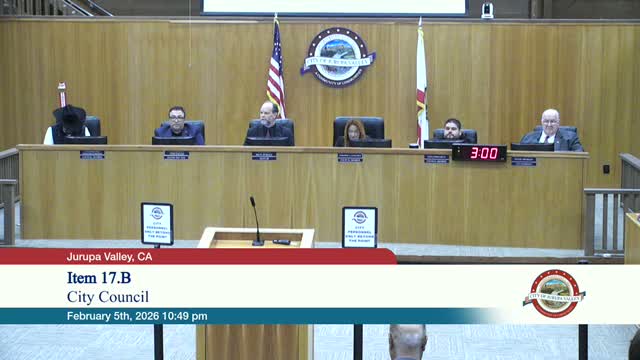
City staff described a three‑phase approach launched in July: an initial education and warning phase, a citation phase and, beginning in August, an enforcement phase that added impoundments for repeat violators. Joe Perez and Code Enforcement Supervisor Ryan Batista presented program metrics to the council.
Batista said the enforcement team—two full‑time code officers with a dedicated sheriff’s deputy—recorded about 580 vendor encounters over several months, issued 239 citations, and impounded 91 sets of equipment; only two vendors reclaimed their impounded items after meeting education and fee requirements. The city also used targeted physical interventions (signage and landscaping) and expanded outreach materials in English and Spanish to reduce locations where vendors regularly set up.
Perez said the initiative was deliberately humane and compliance‑oriented: early phases emphasized education and helped local vendors obtain permits rather than simply remove operators. The city now counts roughly 36 permitted vendors operating under the new rules.
Because enforcement has reduced the vendor problem, staff said the team will use remaining capacity to address other quality‑of‑life issues such as homeless encampments, abandoned vehicles and illegal dumping, while maintaining the program’s capacity to respond to vending issues.
Councilmembers praised the results and asked staff to continue the targeted approach—particularly when interacting with permitted vendors—to avoid unnecessarily alarming lawful operators when outreach is intended.