Get Full Government Meeting Transcripts, Videos, & Alerts Forever!
Get email alerts on the Land Use topic
No spam. Unsubscribe anytime.
Council votes 5‑0 to deny I‑15 RV and self‑storage project after heated public hearing
Summary
After a multi‑hour hearing with roughly 50 public speakers, Jurupa Valley City Council voted unanimously to deny a proposed I‑15 RV and self‑storage development that would have converted about 14.3 acres for development and conserved ~72.5 acres, citing ownership, conservation consistency, and environmental concerns.
Jurupa Valley City Council voted unanimously to deny the land‑use entitlements for a proposed RV and self‑storage development adjacent to the Santa Ana River corridor, after a contested public hearing that drew dozens of commenters and a multi‑hour presentation by staff and the applicant.
Staff summarized the application as a master plan with a roughly 136,000‑square‑foot self‑storage building, an RV parking area of about 77 stalls, a borrow area to lift development out of the floodplain and an approximately 72.5‑acre conservation lot. The project would have required a general plan amendment, zone change, conditional use permit and site development permit for Lot 1 and a tentative parcel map to separate the development parcel from conservation land.
Senior Planner Reynaldo Aquina told the council that the project team had conducted environmental review under a mitigated negative declaration (MND), completed a joint project review with the Western Riverside conservation authority, and proposed mitigation measures and a 72.5‑acre preservation area. He also summarized public comments and the Planning Commission’s recommendation to approve.
Developer Steve Galvez and counsel presented the applicant’s position, saying they had invested in biological studies, site cleanup and security; argued the area is plagued by dumping and encampments; and said the proposal would provide much‑needed RV parking and relatively low daily trip generation. Galvez said the project would bring security and ongoing maintenance to a site he described as chronically misused and costly for private owners to maintain.
Opponents, including many Riverbend residents and environmental advocates, urged the council to preserve land designated for watercourse, watershed and conservation use. Speakers raised concerns about rezoning conserved land, possible impacts on habitat and the Santa Ana River corridor, floodplain compatibility, fire risk from stored recreational vehicles, and a perceived lack of trust because portions of the parcel are owned by a conservation entity (Southwest Regional Management Agency / SWARMA) while a narrow access strip remained in the developer’s control. "Once this land is rezoned, it's gone forever," one opponent warned, calling the change a permanent loss of protected open space.
Councilmembers questioned the environmental review choice (MND versus an EIR) and pressed staff on the Western Riverside Conservation Plan findings, FEMA/LOMR flood mapping, and the legal mechanics by which parts of the site would be deeded back to the developer under the purchase/sale agreement. Staff and the applicant explained a deed‑back process laid out in the sale agreement that would delineate the 14.29 acres of developable upland and record a grant deed back to the seller upon parcel map adjustments.
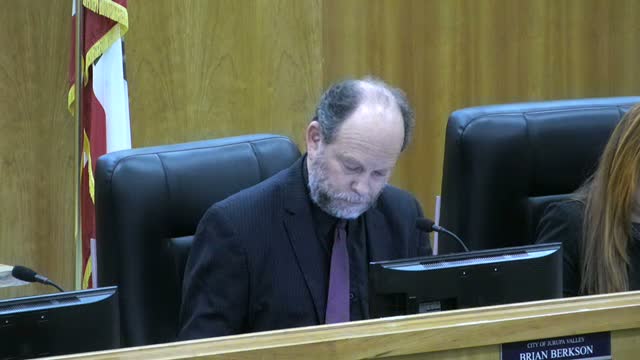
After extended deliberation—during which several councilmembers said rezoning watershed/conservation land posed policy risks and precedent concerns—Councilmember Carmona moved to deny the land use application; the motion was seconded and passed 5‑0. City staff recorded the action as a denial of the discretionary entitlements associated with the I‑15 RV/self‑storage proposal.
The denial does not invalidate ongoing conservation ownership or other environmental processes on the larger site; council members emphasized that the decision reflects their present policy judgment about rezoning conserved watershed land and the available environmental justification. The council did not approve the general plan amendment or rezoning requested for the 14.29‑acre development parcel.
Next steps: staff will file the action and notify the applicant; the applicant retains legal rights including potential appeals or new applications. The project record will remain available in the planning files for any future proposals that might address the council’s concerns.