Get Full Government Meeting Transcripts, Videos, & Alerts Forever!
Get email alerts on the Mediation Program topic
No spam. Unsubscribe anytime.
APO unveils voluntary mediation option for low-level complaints; confidentiality and eligibility draw questions
Summary
Austin Police Oversight presented a voluntary mediation program to the Community Police Review Commission that would offer confidential, virtual mediations for low‑level complaints under a two‑year MOU with the Dispute Resolution Center; commissioners pressed staff on eligibility, recording, and how outcomes will be tracked.
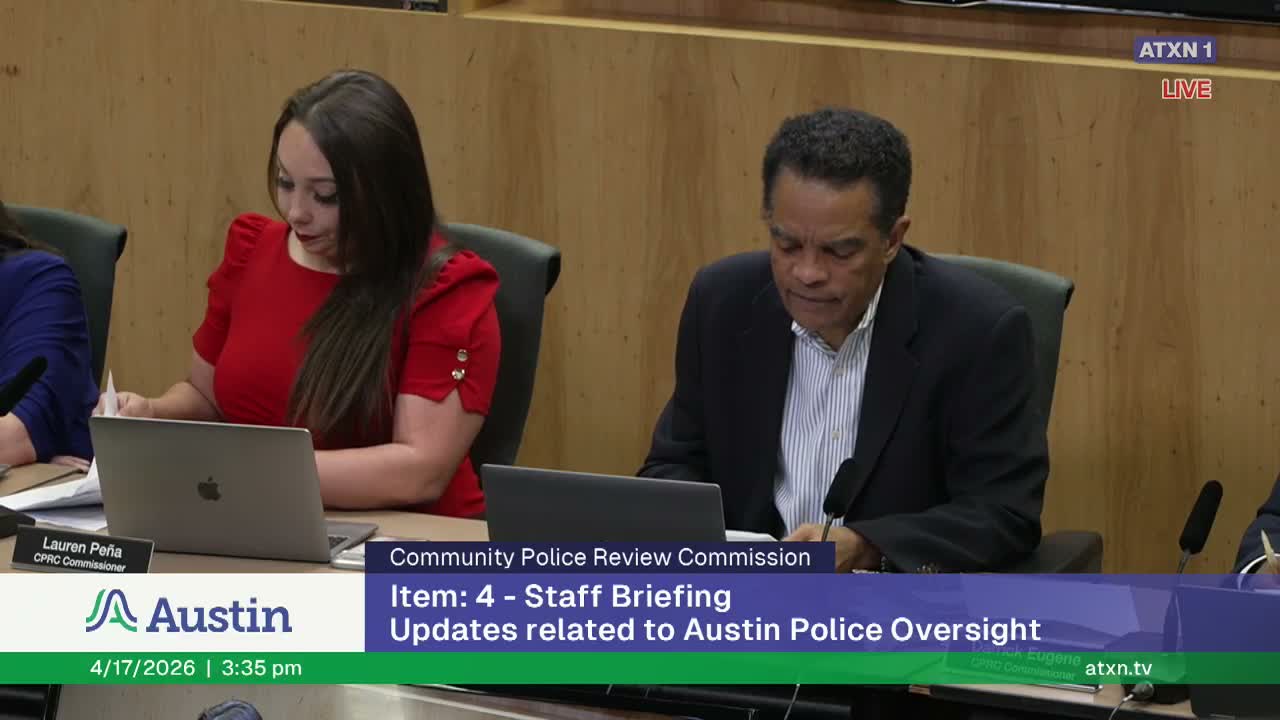
Austin Police Oversight on April 17 told the Community Police Review Commission it has launched a voluntary mediation program to offer community members and officers a confidential alternative to formal investigations for certain low‑level complaints.
Kevin Masters, deputy director of Austin Police Oversight, said APO signed a two‑year memorandum of understanding with the Dispute Resolution Center in November 2025 and that the DRC will serve as the consultant and primary mediator for the program. "We view mediation as a voluntary confidential process in which neutral mediators facilitate dialogue between a community member and a police officer to resolve concerns," Masters said.
The program is intended for ‘‘low‑level’’ allegations such as discourtesy or report‑writing errors, Masters said, and explicitly excludes use‑of‑force and bias‑based policing complaints. He said mediations will be conducted virtually; DRC will provide technology for participants who lack it; and that if an officer fails to attend, the case will default to a formal investigation.
Commissioners pressed staff on several procedural points. One asked why the process must be confidential; Masters replied confidentiality encourages candid participation and protects complainants’ personally identifiable information. A commissioner asked whether officers who acknowledge policy violations during mediation could still face discipline; Masters said that for low‑level matters the program is designed to avoid subsequent punitive discipline and that acknowledgement in mediation would generally close the matter without formal punishment.
Questions also focused on transparency and recordkeeping. Masters said APO will receive an after‑action report from DRC noting whether mediation occurred and whether it was deemed successful, and that APO plans to track mediations and flag repeat episodes so patterns can be escalated: "We will keep track of them in our office," he said. He added the contract is structured with a two‑year maximum of $6,000 and mediations will be charged per case.
Several commissioners said they wanted a clearer rubric showing examples of what constitutes an eligible ‘‘low‑level’’ complaint. Masters said staff will prepare a one‑page outline of typical eligible complaints for the next meeting. He also confirmed there will be no body‑worn camera recordings of mediation sessions and that whether mediations themselves are recorded will depend on DRC policy.
Why it matters: The program offers an avenue for faster resolution and community engagement that APO says may reduce investigative workload for more serious cases. But commissioners and members of the public urged guardrails — a published list of example eligible complaints, tracking metrics, and clear notices to complainants about the consequences of entering mediation — to guard against perceptions that mediation could be used to sidestep accountability for more serious misconduct.
APO said it has not yet processed any formal mediation referrals since the MOU was signed. Staff said mediations will be scheduled within 30–45 days when cases are identified as eligible. Masters and director Gail McCant said they will present a short eligibility list and additional implementation details at the commission’s next meeting.