Wausau transit commission authorizes director to sign letter backing federal bus-operator safety bill
Loading...
Summary
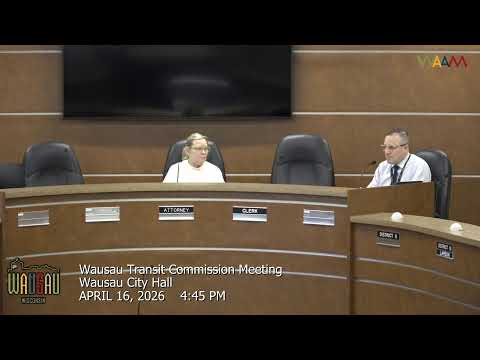
After public testimony from ATU Local 1168, the Wausau Transit Commission voted unanimously April 16 to authorize its transit director to sign a letter urging congressional leaders to include HR 6635, a bipartisan bill that would require enclosed operator workstations on new buses.
Wausau — The Wausau Transit Commission voted unanimously April 16 to authorize its transit director to sign a letter urging congressional leaders to include HR 6635, the Bipartisan Bus Operator Safety and Security Act, in upcoming federal surface-transportation legislation.
Kyle Hanson, president of ATU Local 1168, told the commission he supports the bill and urged local action. “We’re pushing for Congress to require new buses to be equipped with fully enclosed bus operator workstations to keep unauthorized people, objects, and fluids out of the driver’s area,” Hanson said during the public-comment period. He cited Federal Transit Administration data and said, “nationwide in 2024 … there were over 16,000 assaults on transit workers,” a figure he described as evidence of rising threats to operators.
Ron, MetroRide’s transit director, told commissioners he had collected information on enclosed-door products and included photos in the meeting packet. “The cost of one of these in a new bus is about $13,500 per bus additional,” Ron said, adding that manufacturers such as Aero Global measured Wausau’s buses while developing the products. He also recounted recent local incidents and said management has suspended passengers after threats.
The commission’s action—taken after Ron described the product and Hanson’s testimony—was a motion to allow the director to sign the petition in support of HR 6635; the motion passed unanimously. No city funds or procurement commitment were made at the meeting.
Why it matters: Commissioners framed the measure as a safety and advocacy step rather than a local procurement decision. Commissioners and the union described the legislation as a way to establish a national standard for operator protection; the letter directs congressional leaders to consider the bill but does not obligate the city to purchase equipment.
Next step: The transit director will sign and transmit the letter to congressional leaders as authorized by the commission.