Get Full Government Meeting Transcripts, Videos, & Alerts Forever!
Get email alerts on the Public Safety topic
No spam. Unsubscribe anytime.
Lucas selects Director of Public Safety, hears plan to stand up city police department
Summary
The Lucas City Council heard a detailed plan from Director of Public Safety Doug Kowalski outlining legal steps, staffing, accreditation and an initial $1.3–$1.5 million budget to create a city-operated Lucas Police Department focused on community policing and local accountability.
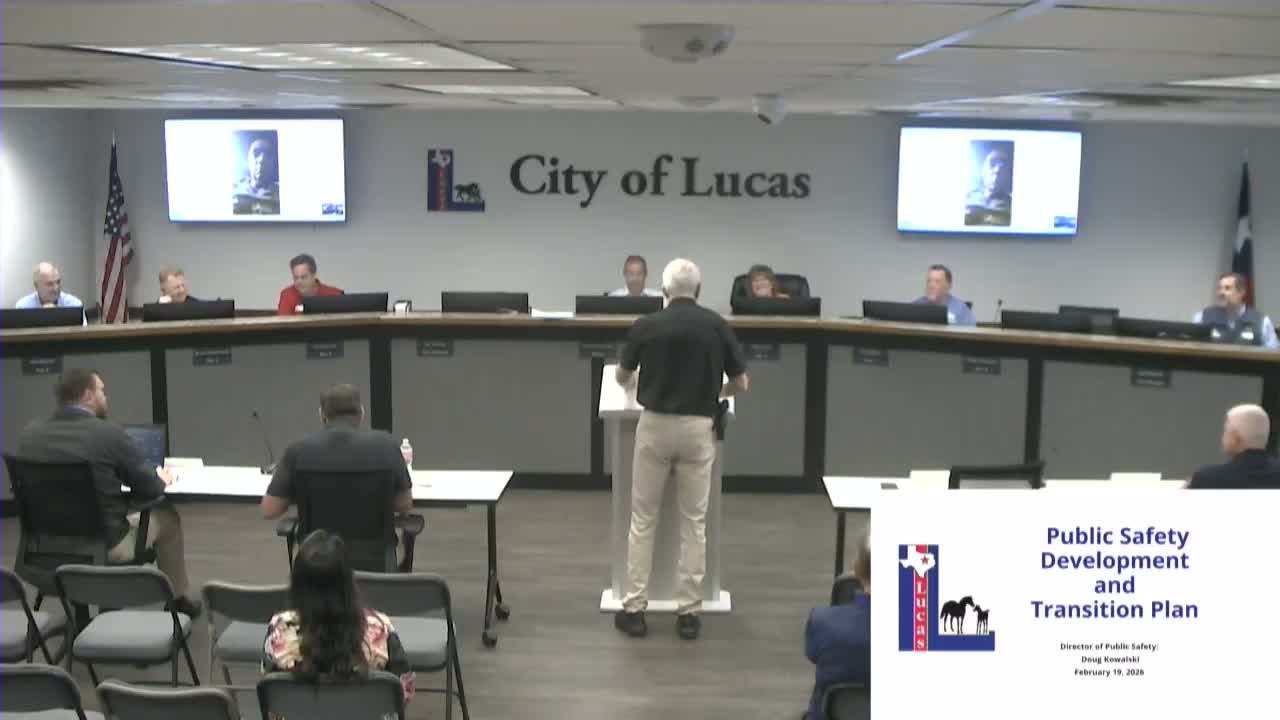
The Lucas City Council on Feb. 19 heard a presentation from Director of Public Safety Doug Kowalski about creating a city-run police department and the steps needed to stand it up.
Kowalski, who the council introduced as the Department of Public Safety Director, told the council the city currently is patrolled under contract by the Collin County Sheriff’s Office but that a local department would allow “community‑oriented policing” and “local control and accountability.” He said the ordinance the council will adopt later would define jurisdiction, authority, organizational structure and funding, and that the department must register with the Texas Commission on Law Enforcement and comply with state licensing and training requirements.
Kowalski outlined an initial operational model for a community of roughly 9,200 residents that would start with about eight officers—including two sergeants, an assistant chief and the chief—serving patrol and supervisory roles, and rely on lateral hires rather than academy recruits at launch. He said the preliminary budget submitted to the state was about $1.5 million; the city’s internal budget figure discussed was approximately $1.3–$1.4 million.
“We want friendly officers. We want beat cops,” Kowalski said, describing an emphasis on officers embedded in schools and neighborhoods rather than a high‑crime enforcement model.
Council members questioned how the Texas licensing and registration timeline (TCO) fits the proposed milestones and how the small initial staff would provide 24/7 coverage. Kowalski said he has already engaged the regional TCO director and expects the paperwork to move in time with the proposed schedule; he said staffing gaps would be managed with 12‑hour shifts, supervisory overlap and overtime if necessary, and that mutual‑aid agreements with neighboring agencies would be part of a broader coverage plan.
During public comment, resident Darryl Schulman welcomed Kowalski and said he was concerned the staffing numbers could leave the department stretched thin; Kowalski responded that initial assignments would be adjusted as call loads are measured and the staffing model refined.
The presentation outlined additional steps the city will need to take, including drafting ordinances, adopting model policies (use of force, complaint intake, internal affairs), registering with state authorities, implementing records management in compliance with the Texas Public Information Act, and membership in regional mutual‑aid agreements tied to grant eligibility. Kowalski also recommended pursuing accreditation from the Texas Police Chiefs Association as a long‑term goal.
No formal motion was taken on Feb. 19; council members directed staff to continue work on ordinances, staffing plans and timelines and to return with contract and budget specifics for future council action.