Get Full Government Meeting Transcripts, Videos, & Alerts Forever!
Get email alerts on the Education topic
No spam. Unsubscribe anytime.
Cochise County school superintendent reviews budget, urges ESA accountability and narrows focus for New Crossroads
Summary
County School Superintendent Dr. Jackie Clay presented a FY2027 operating-budget review, said ESSER federal COVID funds expired in September 2024, announced New Crossroads Academy will focus on Cochise County students only, and urged state-level accountability for Empowerment Scholarship Accounts (ESAs).
Dr. Jackie Clay, Cochise County school superintendent, told the Board of Supervisors on April 16 that the office’s FY2027 request seeks only a 3% cost-of-living increase and that the end of federal ESSER funding in September 2024 has reduced revenues back to pre-pandemic norms. “That is because the ESSER grants expired September 2024,” Clay said, summarizing a multi-year revenue decline.
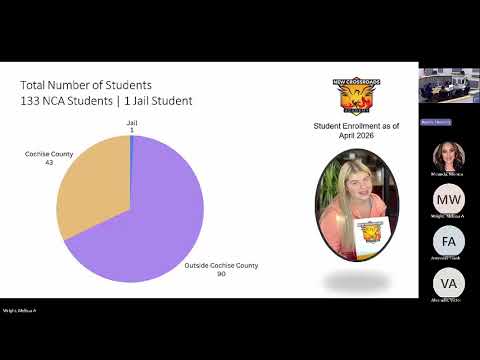
Clay used the board briefing required by Arizona Revised Statutes to outline services and to report on New Crossroads Academy, the county’s accommodation (dropout-recovery) school for high-risk students. She described New Crossroads as focused on students roughly 16–22 years old and said the program will narrow enrollment to Cochise County residents by June 30 to reduce operational strain. “We’re just gonna focus on Cochise County students,” Clay said, adding that the office plans to end a partnership contract and operate the academy independently.
Clay reported outcomes and caseload details for the program: 45 students are currently served in Cochise County (including eight in Douglas), the office has graduated 239 students since starting the program in 2021, and the program maintains one student in the county jail and two in a detention facility out of county. She stressed intensive outreach and mentoring for older students who are often one or two years behind on credits.
The superintendent raised concerns about the state Empowerment Scholarship Account (ESA) program, saying local schools lack visibility into ESA students’ academic progress. Clay asserted the ESA enrollment has grown substantially statewide and called for an accountability mechanism that would tie funding to demonstrated student learning. “We went from 11,000 to 100,000 students that went on ESA now,” she said, and argued for annual testing and the kind of oversight proposed in what she described as an “ESA Accountability Act.” Board members and staff discussed that oversight for ESA students is a legislative matter and that local districts have limited enforcement options.
County administration provided the board a brief fiscal note: a projected $54,396 increase in general-fund support driven by lower indirect-cost reimbursements, a $2,522 market adjustment already granted to the superintendent’s office for the year, and a small operational rise of roughly $1,341. Officials noted grant funds are balancing across multiple grant streams and that the remaining ESSER budget has been eliminated. Stacy (county administration) said several grants reflect carryforward cash balances or off-cycle federal timelines, which affects reported fund balances.
No motions or votes were taken during the briefing. The board confirmed it would continue to monitor the superintendent’s budget request and the accommodation-school contract changes; the work session moved immediately into the board’s next meeting without formal action on the items discussed.