University of Washington panel: World Justice Project data and experts warn of global declines in judicial independence, urge clearer definitions and public-eng
Loading...
Summary
Speakers at a University of Washington panel said new World Justice Project data show broad declines in rule-of-law measures — including significant weakening of judicial constraints — and urged clearer definitions, local outreach and defensive strategies to protect courts.
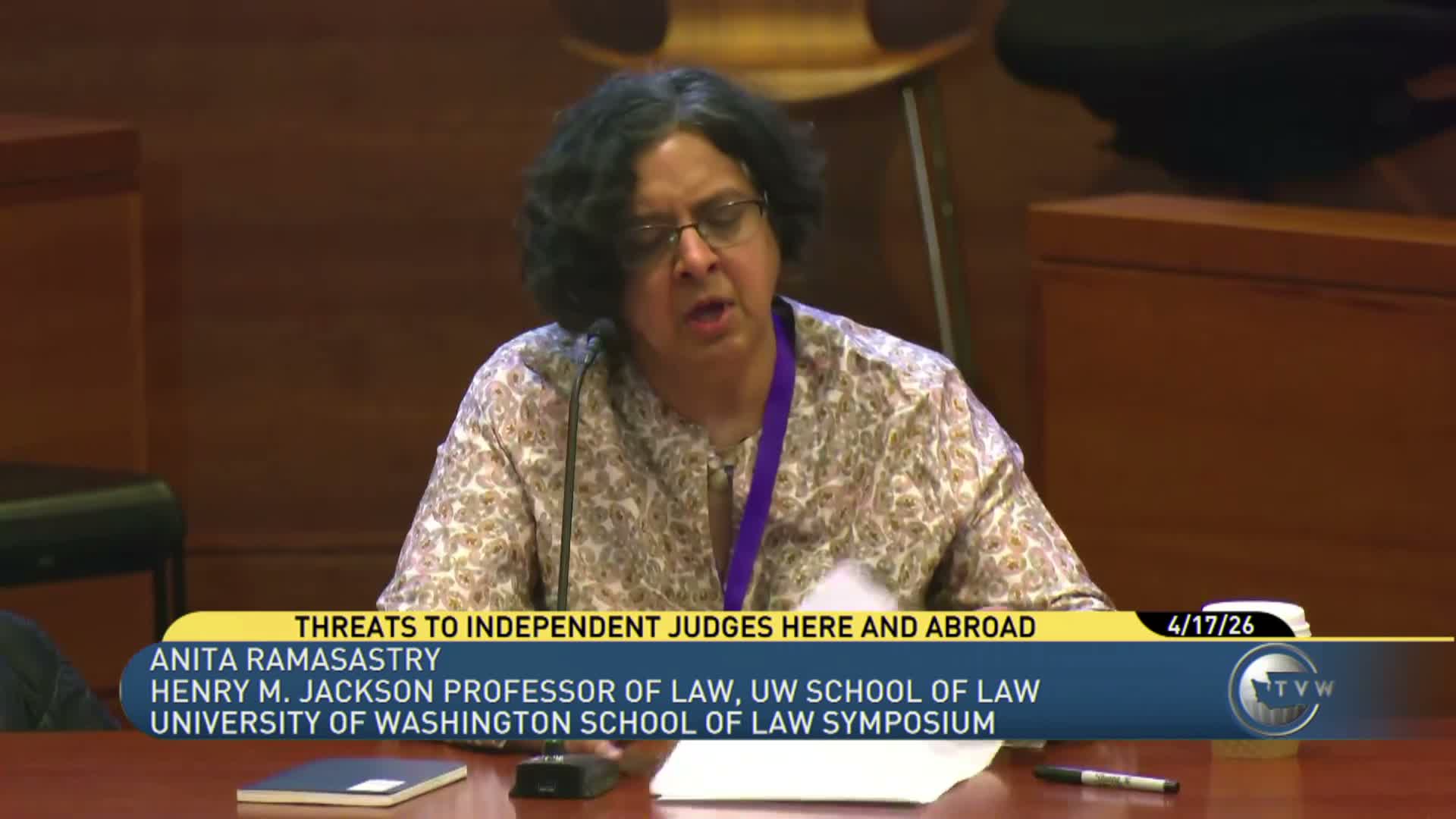
Anita Ramasastry, director of the Barer Institute for Leadership in Law and Global Development at the University of Washington, opened an afternoon panel on judicial independence that placed U.S. developments in a global context and invited data-driven and comparative responses.
Alex Ponce, executive director of the World Justice Project, presented the WJP Rule of Law Index and described its methodology and recent trends. He said the WJP measures countries on a 0–1 scale, covers 143 countries and that the latest data draw on household and practitioner surveys conducted over several years. "We interviewed more than 200,000 households over several years," Ponce said, and the most recent edition included interviews with "more than 4,000 lawyers." He reported that "almost 70% of the countries in the world declined between 2024 and 2025," and that roughly 61% of countries showed weakening constraints on executive power — indicators Ponce said reflect declines in judicial independence. Ponce said the WJP is developing additional indicators to capture both de jure and de facto aspects of judicial independence and accountability.
Meg Satterthwaite, professor of law at New York University and Special Rapporteur on the Independence of Lawyers and Judges for the U.N. Human Rights Council Special Procedures, offered a four-part typology of threats to courts: capture, curbing, instrumentalization and weaponization. "The first is...capture," she said, describing strategies such as creating vacancies and changing court structures to place loyalists on benches. She cited examples including legislative and regulatory changes in Poland and Hungary, large-scale dismissals of judges in Tunisia and Turkey, and uses of disciplinary or criminal processes to target judges, as seen in Guatemala.
Judge Rosemary Barquette, who serves on the Iran–United States Claims Tribunal at The Hague and previously sat on the U.S. Court of Appeals, emphasized the need for semantic clarity when discussing "rule of law" and "judicial independence." She described how measures aimed at court actors can be coercive, citing U.S. sanctions imposed on International Criminal Court staff and judges in 2020 — measures that she said were later lifted and then reimposed in 2025 — as an example of pressure that affects individuals' banking and travel, and she urged sustained international discussion of norms protecting judges.
Professor Clark Lombardi, a scholar of Islamic and comparative constitutional law, urged judges and advocates to localize explanations of judicial decisions so they resonate with publics. He argued that in some countries the incorporation of religious or culturally resonant language into constitutional reasoning has allowed judges to articulate liberal ideals in terms that are persuasive to local populations and thus rebuild legitimacy.
Across the panel, speakers returned to two recurring recommendations: (1) pursue clearer, shared definitions of "rule of law" and "judicial independence" and (2) invest in public-facing communication and institution-building tailored to local contexts. Panelists pointed to specific pressures in the United States — including reported disciplinary measures involving Department of Justice personnel and state-level attempts to increase legislative influence over judiciaries — and urged attention to both legal safeguards and public outreach.
The panel concluded with organizers announcing the program would resume the following morning.