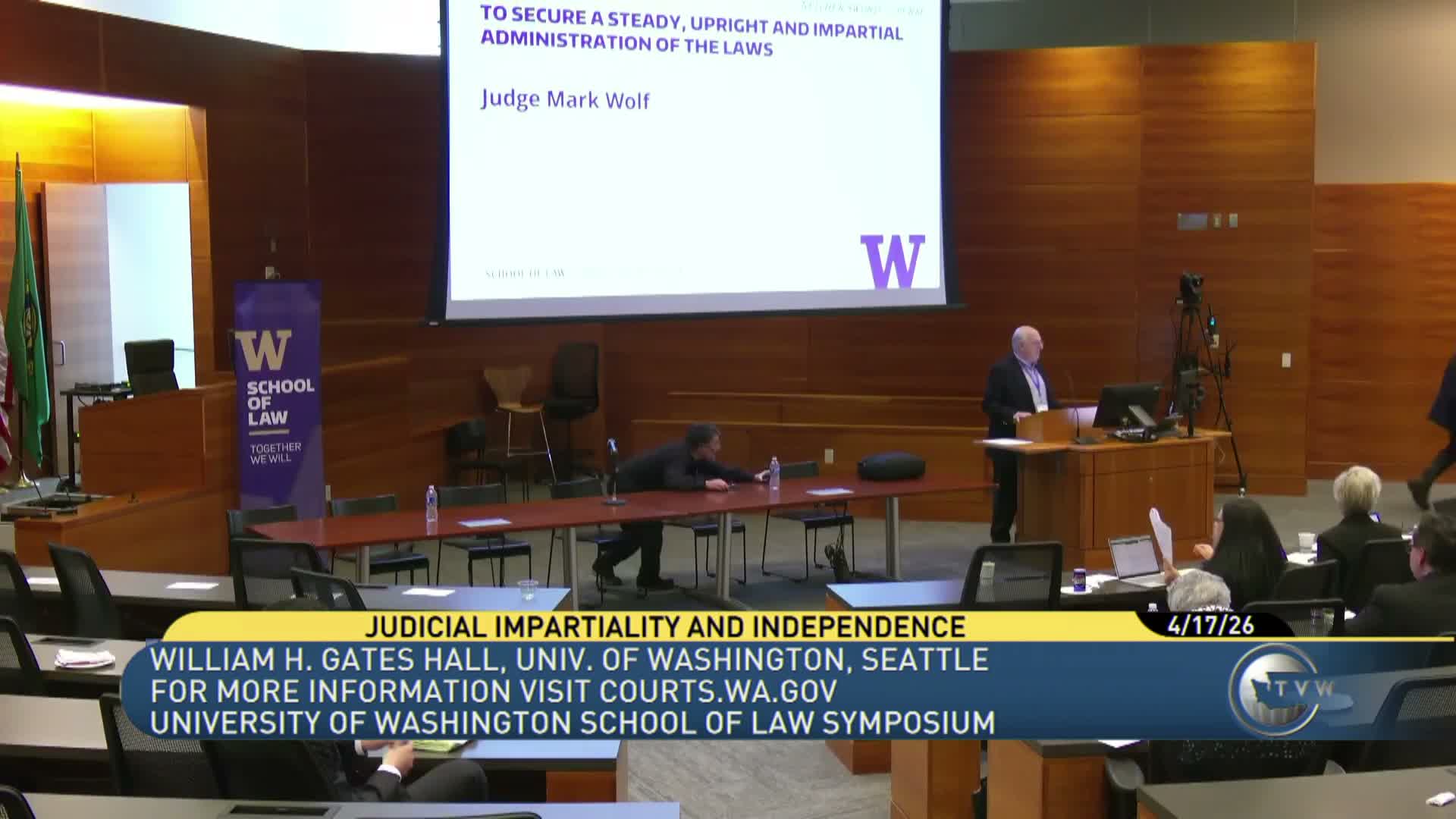
Retired Judge Mark Wolf says executive defiance of court orders threatens rule of law
Loading...
Summary
At the University of Washington symposium, retired U.S. District Judge Mark Wolf described his resignation and warned that the judiciary relies on public insistence for enforcement of orders; he cited examples he said show executive noncompliance and urged coordinated legal and civic action.
Retired U.S. District Judge Mark Wolf told a University of Washington audience that he resigned in part because he feared the American political system might no longer insist that a president obey court orders.
"I resigned in meaningful measure ... because I don't have confidence that the American people would do the same today," Wolf said, explaining his decision to step down and to speak publicly. He added: "We don't have the purse. We don't have the sword. As Hamilton said, all we have is the ability to issue orders and hope that the American people will insist that the president obey them."
Wolf reviewed examples he said illustrate problems with enforcement. He referenced coverage and studies—citing a Washington Post analysis he discussed earlier and a New York Times study reported to show executive noncompliance in a substantial fraction of cases that involved the administration—and described instances in which judges sought contempt proceedings or other remedies that were then limited by appeals or other legal obstacles.
Wolf urged the organized bar, former judges and pro-democracy groups to coordinate responses: "The organized bar would come to the defense of judges who are under attack. And now, that's not as common," he said. He called for more litigation and civic organization to protect judicial independence and recommended engagement with younger cohorts, students and grassroots networks to build a broader constituency for the courts.
The panel also included discussion of whether criminal contempt or other enforcement tools are being fully pursued in recent cases. Wolf said civil and criminal contempt proceedings are an essential part of a court's claim to effectuate its orders and expressed concern that legal and political factors are making those remedies harder to pursue.
Wolf closed by urging broad institutional coordination and persistent public education to preserve the judiciary's capacity to hold officials to the rule of law.