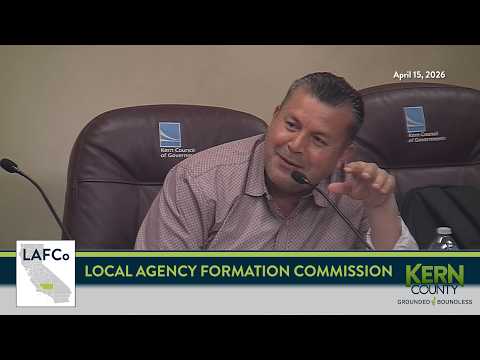
Kern LAFCO accepts Delano municipal service review, flags police, fire and wastewater needs
Loading...
Summary
LAFCO staff found Delano's municipal services generally acceptable but identified resource and coordination challenges for police, fire and wastewater; the commission accepted the MSR and recommended continued planning and interagency coordination.
Kern LAFCO on April 1 received and adopted a municipal service review (MSR) of the City of Delano that finds the city is generally providing essential services but faces operational pressures that warrant continued long-term planning.
Executive officer Blair presented the MSR prepared under the Cortese'Knox'Hertzberg framework, saying it reviewed water, wastewater, police, fire and other municipal functions and concluded the city currently provides services at "a generally acceptable level" while identifying ongoing operational challenges.
The report specifically noted policing and fire-service workload and staffing constraints and recommended continued coordination and facility planning; staff said Delano will likely need to build and operate a third fire station as the city grows. For water and wastewater, the MSR emphasized the need for capital investment to support projected population growth and noted that Delano and neighboring McFarland are working on treatment-plant expansion plans. The staff report characterized the MSR as informational, not a CEQA project, and recommended the commission receive the review and give direction to staff on MSR determinations.
City-contracted planner Steve Brandt and Delano senior planner Jose Lara answered commissioners'questions about proposed fire-station siting (noting a southwestern area near Stradley Avenue and a county transfer station) and whether the MSR requires its own CEQA documentation. Brandt said the MSR is normally informational and not a CEQA "project," though some MSRs that accompany sphere-of-influence amendments can require separate CEQA analysis. Commissioners pressed for clearer documentation in the administrative report about CEQA conclusions so the record shows whether an MSR stands alone.
Commissioners also raised mapping and governance questions: staff acknowledged some Delano sphere-of-influence boundaries extend across the county line into Tulare County under longstanding inter-county service agreements; the MSR suggested that interagency coordination could yield efficiencies, for example on wastewater treatment.
The commission voted to receive the MSR and provide direction to staff; no sphere-of-influence changes were recommended at this time.
Provenance: Staff presentation and Q&A (timeline SEG 396'SEG 699).