Get Full Government Meeting Transcripts, Videos, & Alerts Forever!
Get email alerts on the Housing Affordable topic
No spam. Unsubscribe anytime.
Council delays final decision on 80‑unit Camino Terrace affordable housing project after heavy public concern
Summary
Jurupa Valley council heard a revised proposal from Wakeland for an 80‑unit affordable housing project that moved all buildings to a 5.88‑acre southern parcel. Residents raised safety, blasting, parking and evacuation concerns; the council left the public hearing open and continued the item to Feb. 19, 2026 for a final decision.
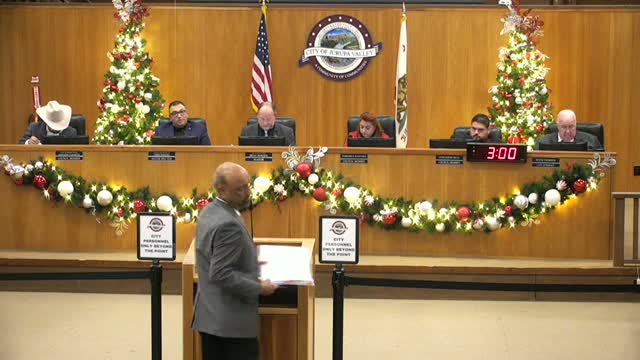
Jurupa Valley City Council on Dec. 18 heard a revised proposal from Wakeland Housing to build an 80‑unit affordable housing development, Camino Terrace, and decided to continue the public hearing to Feb. 19, 2026.
Principal Planner Rob Gonzales summarized recent changes to the project’s site plan: Wakeland moved the project entirely to the southern parcel, reducing the plan to about 5.88 acres while keeping the same unit count and integrating supportive services, a manager’s unit and a community building. Gonzales said staff identified roughly 15 waivers that would still be required under the project’s density‑bonus approach and noted the item’s timeline constraints under the Housing Accountability Act. He said the applicant had proposed about $600,000 in frontage sidewalks to improve connectivity and an additional $200,000 to provide on‑site backup generators for the community building.
Michael Bussey, Wakeland’s project manager, told the council the developer had consolidated services on the south parcel, added ADA ramps and internal connectivity and agreed to build sidewalks that connect to existing infrastructure. Bussey said engineering work and financing make full undergrounding of utilities along Camino Real infeasible — he estimated undergrounding at about $1 million and said it could delay construction by roughly a year — and said Wakeland had filed for density‑bonus incentives consistent with state law to offset such costs. He also said the developer will provide a soils study and would install seismic monitors if blasting were required.
Dozens of residents spoke in the public‑comment portion, voicing a number of concrete concerns. Speakers said the project site includes steep grades and that Canyon Terrace and Camino Real include blind corners and a single, steep egress that could impede evacuation in a wildfire or other emergency; several residents urged additional study of evacuation routes and vehicle circulation. Multiple speakers raised the risk that blasting or heavy grading could damage nearby foundations and asked what protections or bonds would be in place to compensate homeowners for vibration or structural damage. Others questioned whether the site can support the proposed parking and whether overflow would push street parking into adjacent neighborhoods. Several speakers also said they remained concerned about wildfire risk and insurance availability given local Cal Fire designations and recent regional wildfires.
Councilmembers responded with a mix of procedural and substantive questions. Some members pressed staff and the developer for written clarifications on the northern parcel that was removed from the current site plan (how it would be reserved or protected from future development), for stricter language in project documents requiring developer responsibility for design or construction defects, and for clearer criteria on allowable time extensions and bonds for corrective work. Councilmember comments emphasized that the version of the plan presented at the meeting was materially different from previously noticed versions and that residents needed more time to evaluate the new layout.
Because the applicant unveiled a substantially revised site plan at the meeting and because residents requested additional time to analyze the changes and submit comments, the council left the public hearing open and continued the matter to Feb. 19, 2026. The mayor noted that Feb. 19 will be the final hearing allowed under state timelines for the item.
What’s next: staff and the applicant will be expected to provide the council and the public with the soil/geotechnical study, a clearer statement about responsibility for the northern parcel, a written summary of the commitments (sidewalks, emergency generators) and any proposed contract language or conditions that would specify developer liability for blasting, drainage or construction defects. The Feb. 19 meeting is scheduled to be the final hearing on the project.