Minn. House Judiciary Committee deadlocks on judiciary budget; courthouse grant boosted but bill fails to advance
Loading...
Summary
The House Judiciary Committee debated House File 3874, approving a one-time increase to courthouse safety grants but rejecting several amendments and failing on a final referral after a 7–7 tie, leaving the judiciary budget bill stalled.
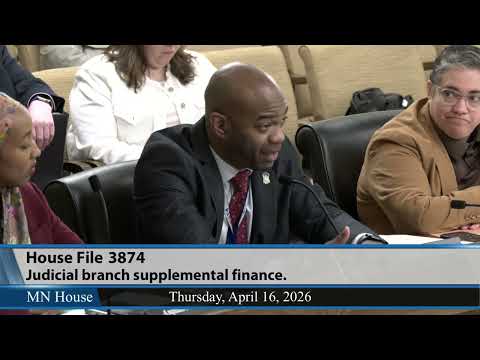
Rep. Liebling presented House File 3874, the judiciary budget bill, outlining requests that included funding for courthouse safety grants, home security for judges and the employer share of paid family and medical leave (PFML) for court employees.
The committee adopted an A7 amendment offered by Rep. Liebling that trimmed some administrator-specific security funding while preserving flexible security personnel funding for the Supreme Court, and later approved Chair Scott’s A4 amendment to raise the courthouse safety grant pool from $1,000,000 to $4,000,000 in one-time funds. Jeff Shorba, the state court administrator, told the committee the grant program has historically left unmet demand and that the funding would be used for hardware such as weapons screening, not ongoing staffing.
Major debates centered on whether the legislature should finance the employer portion of PFML for court employees. Rep. Bliss moved the A2 amendment to remove the PFML operating adjustment, arguing it was an unfunded mandate and citing a cost estimate she said was about $1,900,000 this year and roughly $2,000,000 in later years. "It's taking about $2,000,000 a year out of our taxpayers' pockets to cover something that's an unfunded mandate to the rest of us," Rep. Bliss said. Supporters of funding, including Rep. Feist and Rep. Liebling, defended PFML’s benefits for workers and noted courts cannot raise their own revenue; Rep. Liebling said, "This is a cost that they have come to tell us they are bearing." Mr. Walls provided budget estimates during the hearing, saying the request would be approximately $640,000 in the first year and rise to about $1,043,000 in later years.
The committee held roll-call votes on several amendments. Two member-sponsored amendments addressing Guardian ad litem pay (A1) and the PFML employer adjustment (A2) each failed on 7–7 ties. A proposed A5 amendment that would have deleted certain home-security and appellate/district-court security appropriations and reduced a Supreme Court security staffing appropriation to $312,000 also failed on a roll call. By contrast, Chair Scott’s A4 amendment to increase the one-time courthouse grant pool to $4,000,000 passed by voice vote.
At the end of the session Rep. Liebling renewed her motion to refer HF 3874, as amended, to the Ways and Means Committee. The clerk recorded a roll-call vote that resulted in 7 ayes and 7 nays; the motion did not prevail and the bill did not advance from committee.
The committee’s deliberations repeatedly contrasted the symbolic and practical implications of court security funding: proponents said visible support would help recruit and protect judges facing rising threats, while opponents emphasized fiscal restraint and questioned whether certain home-security expenditures were necessary or duplicative given privacy protections and judges’ salaries.
Next steps: Because the committee did not refer HF 3874 to Ways and Means, the bill will not advance from this committee in its current form unless reintroduced or reconsidered by the committee leadership.