Get Full Government Meeting Transcripts, Videos, & Alerts Forever!
Get email alerts on the Zoning Text Amendments topic
No spam. Unsubscribe anytime.
Planning commission reviews zoning text amendments, proposes changes to use table and downtown overlay
Summary
Staff presented three amendment packages — definitions (including 'limited production'), edits to Table 3 (use table), and downtown overlay revisions aligning with the downtown design manual. Commissioners asked for clearer language on manufactured housing, EV charging, facade materials and repair/replacement standards and directed staff to return with draft ordinance text.
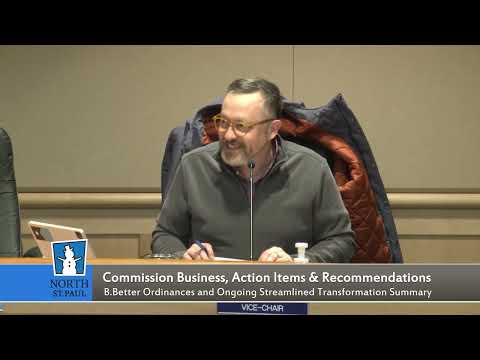
At its Jan. 8 meeting the North St. Paul City Planning Commission examined three staff‑proposed sets of zoning text amendments intended to clarify uses and update downtown design standards.
Ken Roberts, the staff presenter, told the commission the packet contains three discrete amendment packages: updates to definitions (including a proposed clarification of "limited production and processing"), edits to Table 3 (the use table) and a set of changes to the downtown overlay that borrow language from the downtown design manual. "The initiative aims to update selected portions of the city land use regulations," Roberts said, adding staff will bring draft ordinance language and schedule public hearings.
Key discussion points included: • Manufactured housing and home parks: Roberts proposed striking "manufactured housing" as a listed use in the R‑1 single‑family district to remove the option for manufactured home parks in that district. Commissioners emphasized the need to differentiate manufactured home parks from single manufactured homes and asked staff to spell out that individual manufactured or modular homes installed on foundations and meeting code may still be permitted in single‑family districts via clarified table language or conditional use provisions.
• Retail examples and artisan gallery: Staff recommended adding plain‑language examples (deli, bakery, gallery) to make permitted retail uses easier to interpret; commissioners supported the clarity but noted examples should not be exhaustive.
• Fuel sales vs. EV charging: Commissioners debated how to treat fueling and charging. The group agreed to add language after "fuel sales" to reference charging stations (e.g., "fuel sales or charging station" or "fuel/charging") so that EV infrastructure is covered whether accessory to a convenience store or a standalone use.
• Downtown overlay and materials: Roberts proposed importing several standards from the downtown design manual (bay widths, fenestration, façade articulation). Commissioners pressed staff to soften a strict phrase requiring "deteriorated architectural details shall be repaired rather than replaced," recommending instead language that would allow repaired or "replaced with like‑kind design and materials" when necessary. Members also discussed reducing a rigid 100% brick requirement for publicly visible façades to a lower percentage (proposed 75% with stone/veneer allowed) and confirmed variance paths would remain available.
No ordinance votes were taken; staff will redraft the language based on today's input and return with formal draft ordinances and public‑hearing dates.