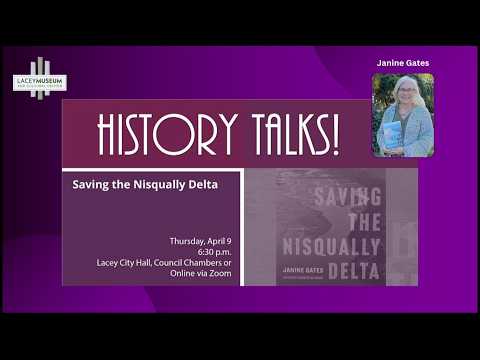
Author Janine Gates traces decades-long fight to save the Nisqually Delta
Loading...
Summary
At a Lacey Museum History Talk, author Janine Gates recounted 50 years of proposals to industrialize the Nisqually Delta, the emergence of local preservation groups and tribal and restoration efforts — and warned that current permit cases and infrastructure projects still pose risks.
Janine Gates, an Olympia-based freelance journalist and author, told an audience at the Lacey Museum that Saving the Nisqually Delta chronicles decades of development pressure, grassroots organizing and restoration work along the Nisqually River.
Gates opened by situating the river: it begins as a glacier on Mount Rainier, runs about 78 miles through three counties and supports critical salmon habitat that helps feed southern resident killer whales. “My book really does begin and end with the tribes,” Gates said, describing visits with Nisqually tribal elders and decades of oral history that shaped her reporting.
The book recounts multiple mid-20th-century proposals to industrialize shoreline and estuarine areas — from Navy and port uses to a 1965 Port of Tacoma feasibility study — and the role that citizen activists played in opposing those plans. Gates credited early local leaders and organizations, including the Nisqually Delta Association, with fundraising for attorneys, organizing public hearings and sustaining long legal fights: “If it hadn't been for them and a whole lot of efforts by citizens, we wouldn't have the Delta that we do today,” she said.
Gates told the audience the association and allied groups pursued litigation and advocacy through the 1960s–80s, and that state-level reforms — notably the Shoreline Management Act of 1971 — and later court rulings changed the regulatory environment. She also noted the 1974 Boldt decision’s effect on tribal voices and resource management, saying tribes now “have a much stronger voice” than in earlier decades.
Gates described more recent conservation milestones: the Nisqually Tribe’s 1999 purchase of about 410 acres of the Ken Braggitt farm and extensive restoration work, including removal of more than 700 acres of dikes by 2009 to restore tidal marsh. She highlighted public education and citizen-science efforts, from school water-quality testing to community field trips, as central to building the broad constituency for protection.
While celebrating past wins, Gates warned of ongoing threats. She pointed to active permit cases involving CalPortland (formerly Lone Star Northwest), saying the company is seeking to expand operations in DuPont and that those proposals are “in front of the hearing examiner right now,” with multiple permit processes still pending. On infrastructure, when an audience member asked about plans to replace the Nisqually Bridge, Gates said WSDOT has completed a planning study and secured funding for preliminary work but still needs construction funding; she added that elevating the I‑5 roadway and realigning McAllister Creek could help salmon migration by restoring better exchange of salt and fresh water.
Former Lacey mayor and county commissioner Karen Frazier, invited to speak, praised Gates’s documentation of the community campaign to save the delta and described chairing the Nisqually River Task Force, which followed a legislative planning process led by Rep. Jennifer Belcher.
Gates urged continued public attention to local planning processes: she said Thurston County’s subarea plan for the Nisqually Valley had not been updated since 1992, a gap she described as inviting potential encroachment, and encouraged residents to follow hearing-examiner cases and comprehensive-plan updates.
The program closed with questions from the audience, anecdotes from long-time residents and a call to action: Gates said the book includes an appendix listing organizations involved with the delta so readers can find ways to participate. Olivia Moore, adjunct curator at the Lacey Museum, invited attendees to purchase Gates’s book and said the museum will hold related events and panel discussions in the coming weeks.