Lifetime Citizen Portal Access — AI Briefings, Alerts & Unlimited Follows
Oregon City planning commission delays decision on 1367 Malala master plan after dispute over geologic‑hazard rules and shared‑use path
Loading...
Summary
After hours of testimony, the commission left the record open and continued deliberations to April 20, citing a late city geotechnical interpretation and unresolved routing and disturbance limits for a TSP shared‑use path through a mapped landslide buffer.
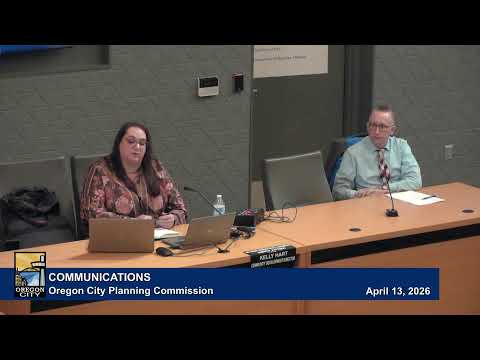
The Oregon City Planning Commission on April 13 left the public record open and continued deliberations to April 20 for a contested master plan and detailed development review for 1367 Malala Avenue after a contested exchange over the city’s geologic‑hazard code and the alignment of a Transportation System Plan (TSP) shared‑use path.
Applicant counsel Greg Hathaway told the commission the project team had worked for a year with staff and had expected staff’s recommendations would allow the project to proceed. He said the applicant’s geotechnical analysis demonstrates the site can be developed safely and urged commissioners to allow the city’s review authority to accept the geotechnical solution. “The review authority may allow development in a known or potential hazard area as provided in this chapter,” Hathaway read to the commission, arguing the code gives discretion to approve engineered mitigation, provided findings support safety and feasibility.
The dispute centers on the city’s interpretation of the geologic hazard overlay code and a practical limit staff said applies to disturbance within mapped landslide or steep‑slope areas: a 4,000‑square‑foot cap on disturbance per parcel in the most constrained portions of the overlay. Assistant city engineer Josh Wheeler and staff explained their analysis showed the proposed road and shared‑use path routing as submitted would exceed that limit for Parcel B and therefore would require revision. “Our geotechnical engineer’s view is the current proposal does not meet code,” staff said in explaining why conditions require plan changes.
Applicant engineers said there are feasible technical fixes. Scott Franklin of Langan Engineering described a soldier‑pile wall, drainage controls and grading that, according to the applicant’s Terracon report, would achieve acceptable static and seismic factors of safety. The applicant offered two street‑level options to address the path: dedicate right‑of‑way now (estimated land cost ~ $200,000) or pay a fee‑in‑lieu of constructing the path now; the team proposed an $80,000 fee as a proportional share to reserve the alignment.
Neighbors testified that the location staff and Metro had previously shown would create a “path to nowhere,” that it could concentrate informal camping and parked vehicles in nearby small neighborhoods, and that ADA and lighting requirements affect feasibility. Joyce Gifford told the commission the currently visible informal path leads to a sewage pump station and warned that building a paved, lit path in the current alignment could become an “attractive nuisance.”
Commissioners pressed both sides for clarifications about which questions the planning commission should resolve now and which should be deferred to parcel‑level detailed development plans. Several commissioners said they wanted the city geotechnical consultant’s written review and more precise alignment and grading information before making a final decision. Planning staff agreed to accept a seven‑day extension from the applicant for a final written argument and to continue deliberations at the commission’s April 20 meeting at 7 p.m.
What happens next: the commission closed oral testimony, left the written record open for seven days for final arguments from the applicant, and scheduled deliberations for April 20. If the commission reaches a different interpretation of the code than staff, it would need to adopt alternate findings; if the commission accepts staff’s interpretation, the applicant may be required to revise Parcel B plans at the DDP stage or appeal to the city commission.
This hearing threaded two separate but related technical issues: the routing, grading and construction standard for a TSP shared‑use path; and whether the geologic hazard overlay allows the proposed amount of disturbance in mapped landslide/buffer areas without alternative findings or code changes.