County review of lighting priorities and Russell Road capacity study recommends multi‑step improvements and $60M concept cost
Loading...
Summary
Consultants presented a TPO lighting study identifying five priority intersections and a Russell Road capacity study recommending a two‑lane divided ultimate section with an estimated concept cost of about $60 million; the study tied lighting to crash‑reduction potential and highlighted federal funding opportunities.
Consultants working for the North Florida Transportation Planning Organization presented two studies to Clay County commissioners on April 14: a countywide lighting needs assessment and a capacity study for Russell Road.
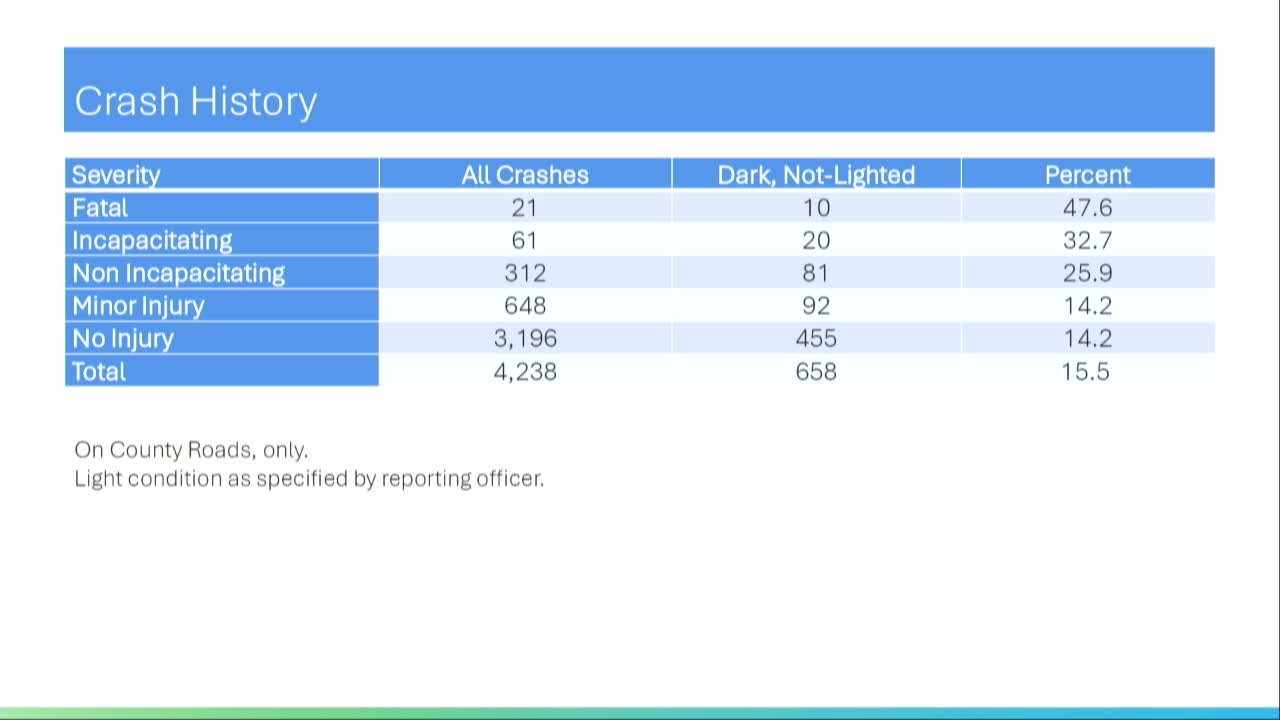
Terry Shaw of Kimley‑Horn summarized the lighting study, saying the team identified five priority intersections on county roads where lighting improvements are expected to reduce crash risk. Shaw cited a five‑year crash dataset (2020–2025) and said county roads had about 4,200 crashes in that period, with roughly 658 identified as occurring in dark or unlighted conditions. Study authors used the Florida Green Book design criteria and developed concept plans and cost estimates for prioritized intersections, including capital, permitting, and operations and maintenance. Shaw noted lighting O&M rates were current as of October 2025 and that utility fuel adjustments can change monthly costs.
On Russell Road, the consultant presented traffic forecasts and alternatives. Under a lower‑growth forecast the study recommended designing an ultimate two‑lane divided typical section (with narrower median and left‑turn treatments) that would achieve the county’s level‑of‑service objectives through 2050. The team estimated a conceptual cost of about $60,000,000 to implement that typical section — including design, environmental mitigation and construction engineering and inspection — and identified nearer‑term safety and connectivity improvements (sidewalk gaps, shoulders) as lower‑cost priorities.
Commissioners discussed tradeoffs between continuous two‑way left‑turn lanes and divided medians, with staff and consultants noting safety evidence that medians can reduce some crash types. Commissioners and staff also asked about funding sources; the consultant pointed to federal opportunities such as the Safe Streets and Roads for All program as potential grant sources for eligible safety projects.
The presentations were informational; commissioners did not take immediate capital appropriations at the meeting but asked staff to track funding opportunities and report next steps.