Get Full Government Meeting Transcripts, Videos, & Alerts Forever!
Get email alerts on the Water Conservation topic
No spam. Unsubscribe anytime.
Clay County proclaims April as Water Conservation Month, partners urge rain-shutoff device use
Summary
The Board of County Commissioners adopted a proclamation recognizing April 2026 as Water Conservation Month and heard partner remarks urging homeowners to install and maintain irrigation rain‑shutoff devices, while utility officials described leak detection and reclaimed‑water outreach programs.
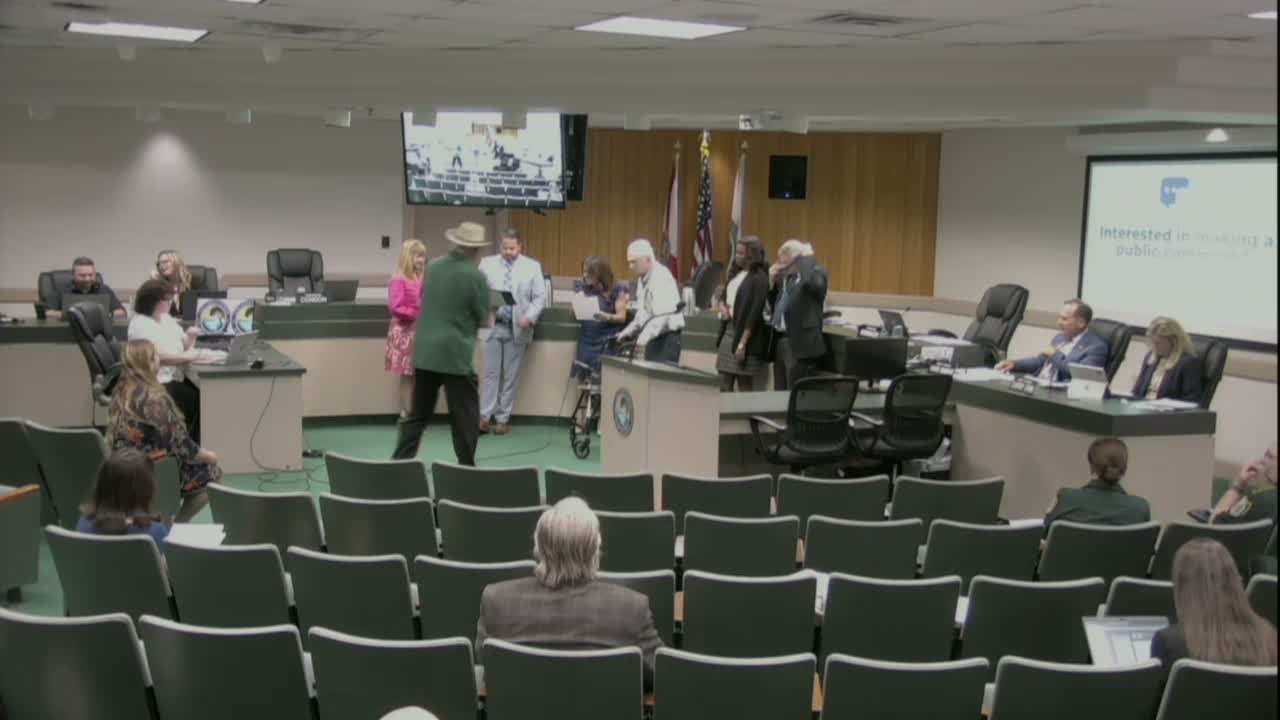
The Clay County Board of County Commissioners on April 14 adopted a proclamation recognizing April 2026 as Water Conservation Month and called on residents and businesses to reduce outdoor water use.
The proclamation, read by a county representative, cited the Floridian aquifer and named the St. Johns River Water Management District, Clay County Utility Authority (CCUA) and the Clay Soil and Water Conservation District as partners in outreach. The board voted to adopt the proclamation on a voice vote.
At the meeting, a water‑management official and CCUA staff described specific conservation measures and programs. The management official urged homeowners to check and maintain rain‑shutoff devices on irrigation systems, noting the device requirement has been on the books since May 1991 and saying many are not functioning. “We want to make sure these devices work,” the official said, arguing that functioning shutoff devices prevent unnecessary watering during rain and can be a “force multiplier.”
Representatives from the Clay County Utility Authority highlighted technology the utility uses to spot continuous usage, saying meters can trigger automatic alerts when a meter runs for multiple days and that the utility offers free water‑conservation assessments to customers. CCUA also said roughly “close to 40%” of its customers receive reclaimed water service, a reuse program the utility cited as a conservation benefit.
Commissioners and board members asked about additional programs. Staff noted a water‑management program that caps abandoned artesian wells; the speaker said the county and district capped 19 wells in the last month, saving about 2,000,000 gallons per day, and reported the program has capped “close to 300” wells since November 2020, a claimed cumulative savings described in the presentation.
The proclamation follows the district and county urging residents to delay nonessential irrigation (for example, new sod installation) and to use the county’s online reporting tool to notify staff of suspected irrigation violations.
The board’s action was procedural: adoption of the proclamation does not create new regulation but formalizes the county’s public outreach for the month. Staff said federal Safe Streets for All and other grant programs could be potential future funding sources for particular capital projects tied to water infrastructure and safety.