Get Full Government Meeting Transcripts, Videos, & Alerts Forever!
Get email alerts on the Road Infrastructure topic
No spam. Unsubscribe anytime.
Lucas City Council hears year-end road-improvement update; staff outlines $1.3 million in recent work and priorities
Summary
City staff told the Lucas City Council the road program spent about $1.08 million on repaving and related work last year and about $1.31 million including culvert/drainage projects; staff outlined 2025–26 targets, three high-priority streets and limits on striping and traffic-calming changes.
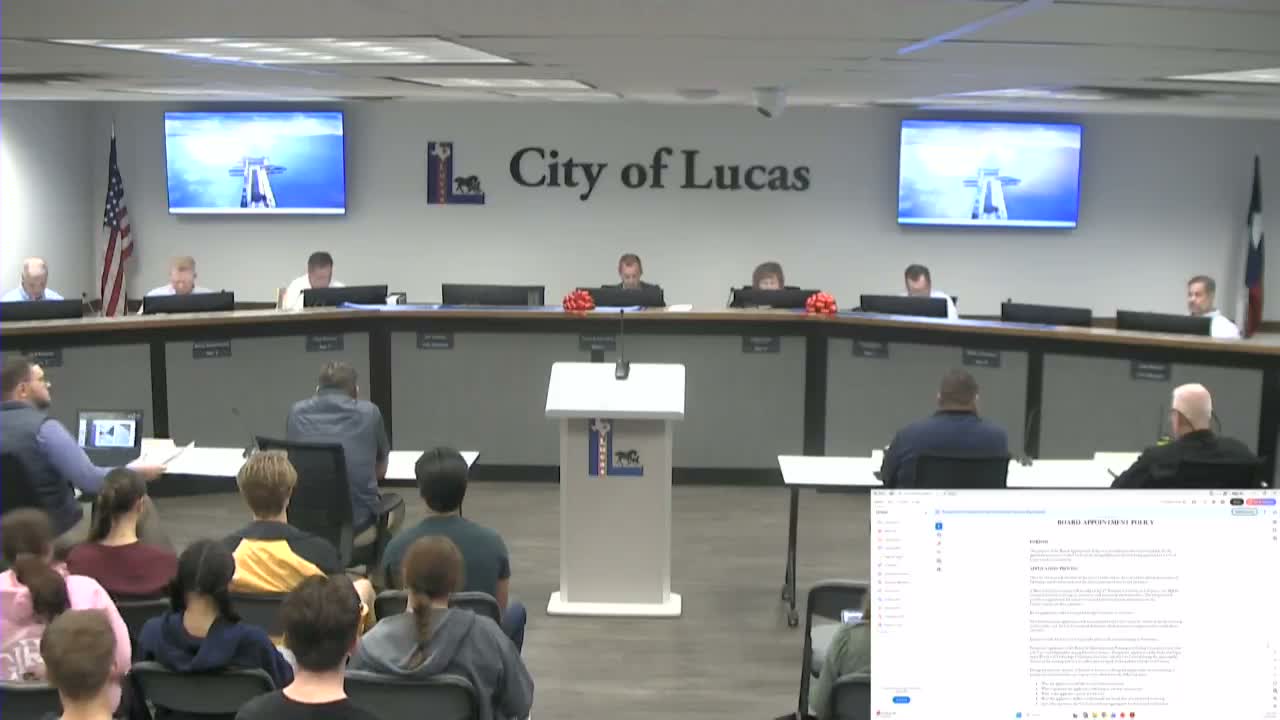
Patrick Hubbard, the city’s capital improvement program manager, told the Lucas City Council on Nov. 20 that the city’s road-improvement program completed a range of maintenance and repaving activities in the past year and presented spending and prioritization plans for the year ahead.
Hubbard said the city spent about $1,079,797 on paving and related surface work, with total program outlays at roughly $1,308,870 once culvert and drainage projects are included. "We spent about $1,079,797" on the repaving work and "altogether, that brought out expenses of $1,308,870," Hubbard said.
The update covered last year’s activities — including work in the Woodmore and Meadows subdivisions and portions of East Windicoff Road — and previewed the 2025 program. Staff described a mix of treatments planned for the coming year: a full system assessment (Smart Pavement Management) estimated at about $15,000; combined asphalt and concrete crack sealing planned at roughly $200,000; onyx seal work budgeted at about $85,000; targeted patch-and-panel replacements; and a culvert/ditch maintenance budget of $207,000.
Council members pressed for measures that translate dollars into network impact. One council member asked whether the spending affected 2% or 5% of city roads. Hubbard said he would provide a calculation in linear feet and updated aggregate pavement-management scores when new data are released in January.
Hubbard highlighted three "special cases" likely to consume a significant portion of next year’s budget: Estates Road (recent water-line work left the surface in poor condition), Ore Road (severe deterioration complicated by a development agreement that may trigger cost-sharing with a developer) and streets tied to a major intersection project expected to conclude in 2026. "Between those two streets, that’s likely to consume a very high percentage of the budget for the year," he said about Estates and Ore roads.
Staff emphasized that project selection uses condition scores but also considers traffic volumes, recent repairs, and safety data. Councilmembers said they want to correlate spending with condition improvement and to track whether the city is making progress toward a five-year benchmark discussed at a spring workshop: moving the system to "fair or better" within five years under an approximate $1.3 million annual program.
On signage and striping, Hubbard said the city follows the Manual on Uniform Traffic Control Devices (MUTCD) and Texas adaptations, so stop signs, centerlines and other changes require engineering review. He explained lane-width constraints: certain stripe configurations can reduce effective lane width and TxDOT standards generally do not permit striping that leaves a lane under 12 feet wide. He noted that only one city street, Highland Drive, meets a 26-foot width threshold that would permit some stripe layouts without further council directive.
Hubbard also addressed traffic-calming: the city generally does not permit neighborhood speed bumps because the International Fire Code and the fire marshal limit approvals due to emergency-response impacts; one existing installation was allowed under a prior, location-specific agreement. On innovative, lower‑cost options — reflectors, targeted striping and high-friction asphalt at problem intersections — staff said they evaluate solutions case-by-case and coordinate with TxDOT when state roads are involved.
Mayor (speaker 1) praised the work, saying the council has increased road funding in recent years and that the city is beginning to make headway. "I wish we had a $13,000,000 road budget," the mayor said, underscoring the scale of need the council faces.
The council requested additional output measures and a follow-up presentation when updated pavement-management data are available in January; staff agreed to provide miles or linear-feet impact calculations and updated condition scores. The presentation was informational and did not include any formal council action.