Get Full Government Meeting Transcripts, Videos, & Alerts Forever!
Get email alerts on the Zoning Policy topic
No spam. Unsubscribe anytime.
Staff and consultant recommend switching in‑lieu fee method and aligning student‑housing rules with other housing types
Summary
Neighborhood Development Services and consultant 3TP Ventures presented findings and recommendations to revise the ADU manual: move to an affordability‑gap (value‑gap) fee method, add an in‑lieu fee for four‑bedroom units, and consider removing the half‑mile student‑housing buffer to reduce incentives driving development into vulnerable neighborhoods.
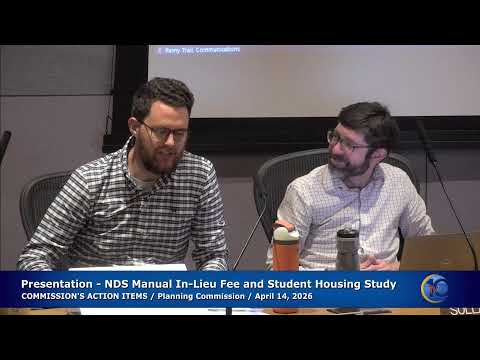
Neighborhood Development Services Director Brown and consultant Amanda Kloper of 3TP Ventures presented a study of the ADU (affordable dwelling unit) manual and potential policy updates focused on student housing and in‑lieu fee calculations.
Brown said the manual (adopted with the development code) treats student housing differently: student projects within a half‑mile of campus are defined by rental‑by‑bedroom and historically were required to pay an in‑lieu fee rather than provide on‑site affordable units. Staff and the consultant tested several fee methods and concluded the current city method (which aligns with construction costs) is unusually high and not the most common best practice.
Amanda Kloper summarized the technical findings and recommendations: use an affordability‑gap (value‑gap) method as a best‑practice alternative to better reflect market valuation, add a specific fee for 4‑bedroom student units, and consider removing the half‑mile student‑housing buffer so student and non‑student housing are treated consistently. "So we are kinda recommending moving forward with the affordability gap as a best practice alternative with more flexibility and better policy alignment," the consultant said.
The team presented feasibility modeling showing the affordability‑gap approach narrows the financial difference between providing on‑site units and paying an in‑lieu fee for most housing types, although student housing remains the most financially feasible product type. Commissioners asked how much the proposed fee changes would affect projects currently in the pipeline and whether additional tools (tax abatements, bonus‑height conditions tied to on‑site units) might be needed to reach desired unit counts and to prevent displacement in vulnerable neighborhoods. Staff said final code amendments would be drafted only after further council review and stakeholder input and noted any changes would apply to projects not yet vested.
What’s next: staff will present the findings to City Council and continue engagement; the presentation is informational and no code changes were adopted at this meeting.