Get Full Government Meeting Transcripts, Videos, & Alerts Forever!
Get email alerts on the Assessment Reading Screener topic
No spam. Unsubscribe anytime.
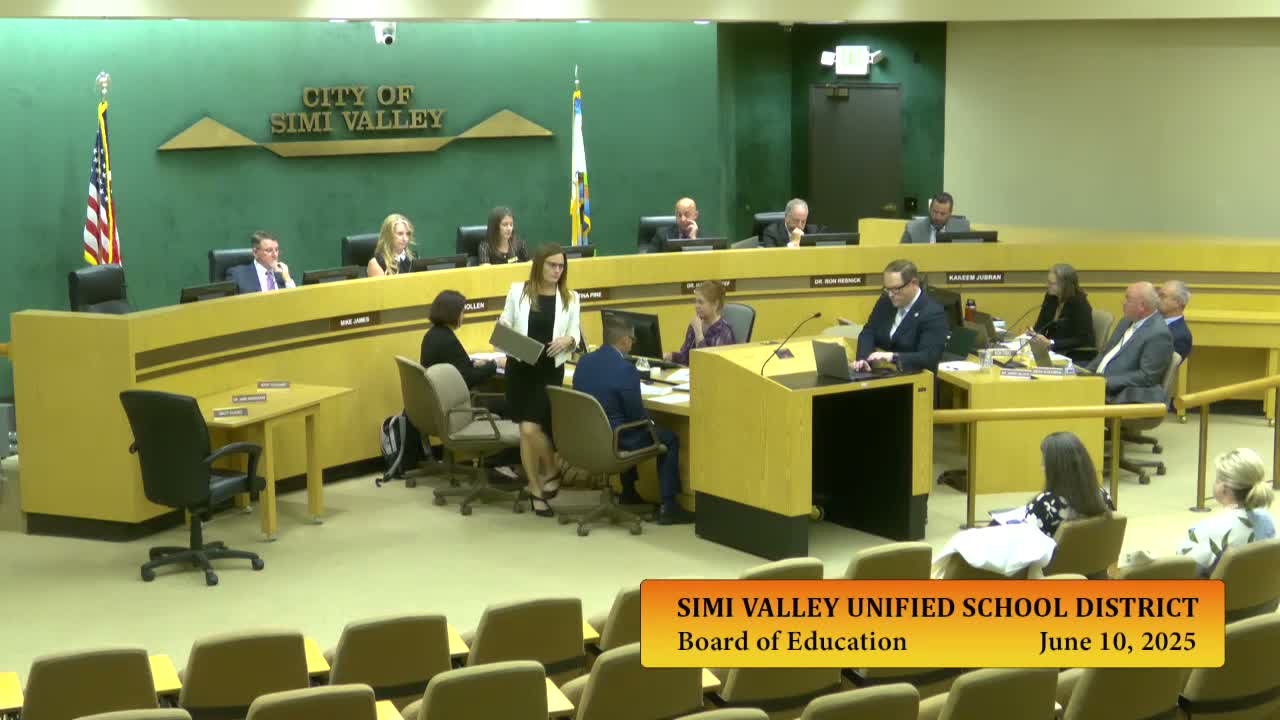
Simi Valley Unified staff recommend mClass/DIBELS as statewide reading screener; board expected to vote next week
Summary
District staff recommended the board adopt the mClass/DIBELS universal reading-difficulty screener for kindergarten through second grade after a district pilot; staff said the state provided about $63,000 for training and that the district's additional purchase cost is just under $16,000.
Simi Valley Unified School District staff recommended the board adopt the mClass implementation of DIBELS as the district's universal reading-difficulty screener for kindergarten through second grade, following a staff-led pilot and task-force review.
Dr. Snodgrass, who led the pilot review, told trustees the state authorized four vendor screeners and the district narrowed the choices to two for classroom comparison. "The recommendation to the board is that we move forward with the mClass DIBELS," Dr. Snodgrass said, citing pilot feedback on reporting, teacher usability and alignment with phonics instruction.
Staff described the pilot: 30 teacher respondents assessed five students each with a mix of on-level, below-level and above-level readers. Pilot respondents praised multitudes for ease of administration but ranked DIBELS/mClass higher for accessible, actionable data and teacher reports. Staff said DIBELS gave stronger data reports while mClass scored higher on ease-of-use metrics in some teacher surveys; the recommendation balances those trade-offs.
The district told the board the state provided roughly $63,000 in one-time funds for training teachers to administer the screener; staff said an additional district purchase for mClass would be "just under $16,000." Staff also said the district will work to house screener results in the student information system (Aeries) so data follow students as they change grades and schools.
Officials emphasized procedural safeguards and parent communication required by state law. "There is parent notification prior and after," Dr. Snodgrass said, and parents will be able to opt out under the Education Code provision described in the presentation. Staff noted exemptions for students already identified with reading difficulties.
Board members and attendees asked about administration time and classroom impact. Staff said a single screener typically takes about five to seven minutes per student and that the district will provide training and logistical supports to minimize class disruption. Staff also said the screener can be given multiple times per year to monitor progress.
The board heard the item as information and will be able to consider a formal adoption vote next week. If approved, the district plans teacher training in August and phased implementation in the 2025'26 school year.
Provenance: This article is based on the board presentation and staff discussion of the reading-difficulty screener (topic introduced at SEG 1980 and discussed through SEG 2566).