Get Full Government Meeting Transcripts, Videos, & Alerts Forever!
Get email alerts on the Agency Report topic
No spam. Unsubscribe anytime.
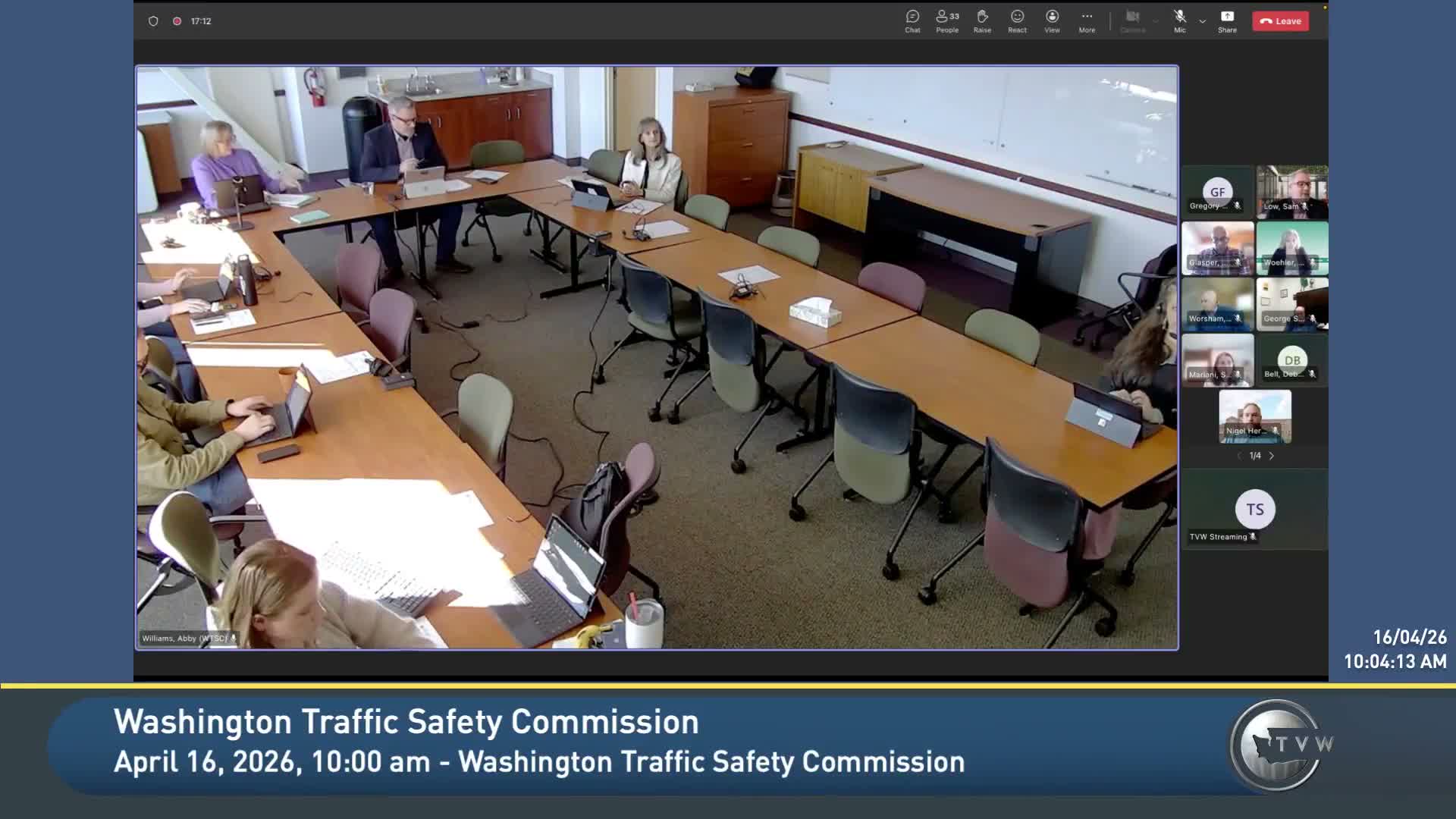
Traffic Safety Commission hears preliminary drop in 2025 fatalities, discusses funding and new truck‑safety council
Summary
At its April 16 meeting the Washington Traffic Safety Commission heard Director Shelley Baldwin report preliminary data showing 659 traffic deaths in 2025 and discussed funding shifts, ignition‑interlock work and implementation of HB 2410 to create a commercial truck safety council funded by a new fee.
The Washington Traffic Safety Commission received a director's report April 16 that described preliminary 2025 traffic fatality counts, new and provisional funding, and policy work ahead of a required July vote on the agency's financial plan.
Director Shelley Baldwin told commissioners the preliminary files show 659 traffic deaths in 2025, noting that the figure is not final because several cases are still under review. "These are not numbers. These represent lives and tremendous losses to families and friends and communities," Baldwin said, adding the preliminary total represents about a 10 percent decrease from 2024. She cautioned that the counts remain above 2019 levels and that work continues to move toward the commission's long‑term zero goal for 2030.
Baldwin said the agency is launching its tri‑annual highway safety financial vote for 2027–2029 and asked commissioners to be prepared to take action in July. She summarized recent legislative outcomes and proviso funding that will affect agency programs, including $600,000 for telematics research and continued support for studies of automated safety cameras in partnership with university researchers.
On impaired‑driving enforcement, Baldwin described a Yakima District Court pilot examining barriers to ignition interlock device (IID) installation among DUI‑supervised clients. The project found many eligible people lack a valid license or have unresolved suspensions or revocations that delay or prevent IID installation, undermining intended sanctions and public‑safety outcomes.
Baldwin also flagged a new state law and proviso funding aimed at improving IID compliance (reported in the meeting as $200,000 for compliance work) and noted an additional roughly $500,000 for tribal DUI grants. She told the commission staff will work with the Department of Licensing and Washington State Patrol on studies and recommendations to tighten IID compliance.
On commercial vehicle policy, Baldwin summarized House Bill 2410, which establishes a Washington State Commercial Truck Safety and Education Council to be housed at the agency and funded by an increase in a fee that presenters said was raised by $16 (to $32 total). Baldwin and presenters said revenue from the fee is anticipated to generate about $5 million per biennium to support council‑recommended training, research and programs. The council will include representatives from state agencies, the trucking industry, labor and higher education, and will develop a charter and operating rules before recommending program priorities.
No formal votes were taken at the meeting. The commission's next scheduled meeting is July 16, 2026, when the financial plan vote will be on the agenda.