Get Full Government Meeting Transcripts, Videos, & Alerts Forever!
Get email alerts on the Land Use Trucking topic
No spam. Unsubscribe anytime.
Residents demand enforcement over alleged illegal truck yards as council approves Esperanza plan changes
Summary
Residents and environmental groups urged the Ontario City Council to revoke temporary use permits and enforce zoning at truck‑parking sites at 7255 and 7435 Shaffer Avenue, citing health and traffic impacts; staff argued the sites and regional logistics context are complex while the council approved related Esperanza plan items and a development agreement 5‑0.
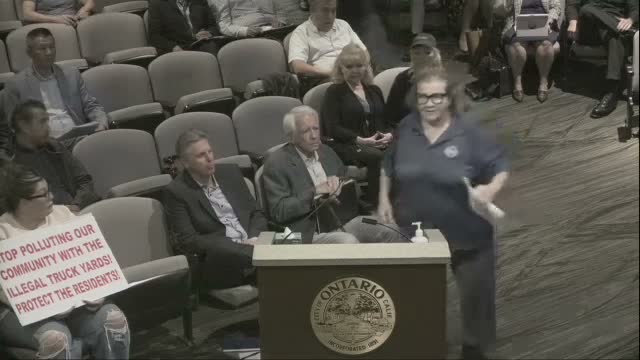
At its November meeting the Ontario City Council heard repeated public pleas to shut down what residents and environmental advocates described as an illegal, long‑running truck yard operation at 7255 and 7435 Shaffer Avenue, and to enforce the city’s temporary use permits (TUPs).
Speakers tied the Schaefer/Shaffer sites to broader concerns about air quality and the Euclid corridor. Jennifer Daley, an environmentalist with the nonprofit Sell It For a Better Tomorrow, told the council: "Revoke the TUPs for '7 Thousand 255 and 7435 Schaeffer and end its fake temporary use." She and other commenters said eyewitness photos and videos show loaded trailers and diesel cabs on‑site, and noted the site had previously been fined $22,000, which speakers said has not stopped the activity.
The council heard variations on the same complaint from other residents and groups. Chris Robles said the community "demand[s] an end to it," describing thousands of trucks stored on former farmland and warning of particulate pollution. A representative from the Inland Valley Advocates said the city is "sliding with corporate polluters instead of protecting residents" and called for transparency about permits and the Euclid plan timeline.
City Manager responded that enforcement work has been underway and urged context: "Here in the Inland Empire, we are the logistics hub of the entire Western United States," he said, arguing that land‑use change, economic conditions and previous policy choices had shaped the current pattern of truck stops and temporary uses. He said code enforcement and the city attorney’s office have pursued illegal operations and that some TUPs were intended as interim measures while market conditions evolved, and invited further face‑to‑face discussion with concerned residents.
Why it matters: public commenters framed the issue as both an enforcement problem (alleged permit violations, a cited fine) and a health problem (diesel exhaust and particulates in an area speakers said already faces poor air quality). City staff framed the issue as one requiring policy responses that balance economic activity, land‑use commitments made during Ontario Ranch annexation and enforcement capacity.
Council action and context: The discussion about truck parking and the Esperanza/Euclid area overlapped with three related public hearings on the agenda. Council approved an ordinance/development agreement (file PDA25‑003) and an addendum to the Ontario Plan 2050 environmental review tied to the Esperanza specific plan, and later approved a general plan amendment for the larger area; each vote was recorded as passing unanimously (5‑0). The developer’s applicant, Jason Lee, spoke at the hearing and offered to answer questions.
The council did not, during the meeting record, vote to revoke the specific TUPs citizens asked about. Instead, staff reiterated offers to meet with advocates and to continue enforcement work; residents left asking for clearer timelines, full public notice and an explicit plan for TUP compliance.
What’s next: Concerned residents asked the city to agendize specific enforcement actions, require public timelines for development, and consider financial or regulatory measures to limit long‑term truck parking in areas anticipated for housing. The council approved the related plan and development items and directed staff to provide additional materials and follow‑up as those projects advance.