Lifetime Citizen Portal Access — AI Briefings, Alerts & Unlimited Follows
Westford begins MSBA-backed feasibility study for Robinson School, seeks public input on three enrollment options
Loading...
Summary
At a community kickoff, Westford Public Schools and consultants described a feasibility study with MSBA partnership, three enrollment/consolidation options, an estimated 48.5% MSBA reimbursement rate for eligible costs, and a schedule of seven public meetings leading to committee votes later this year.
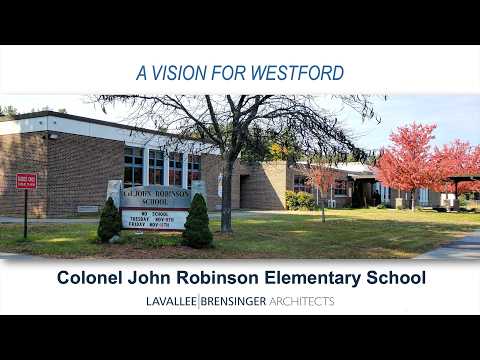
Superintendent Christopher Chu opened a community kickoff meeting to outline a feasibility study for Robinson School and the district’s partnership with the Massachusetts School Building Authority (MSBA).
Chu said the district submitted a Statement of Interest to the MSBA and was invited into an eligibility period that led to the current feasibility phase. “They are reimbursing 48.5% of the eligible costs of the project,” Chu said, describing how the MSBA helps by covering a portion of approved expenses while the district pays costs up front.
The consultants leading the study — architects from LaValle Brensinger and owner’s project manager staff from Vertex — described a year-long feasibility process that will analyze sites, program needs and cost trade-offs. “We’re not going to design anything unless you tell us that’s what you want us to design,” said Lee Sherwood, principal in charge for LaValle Brensinger, emphasizing the meeting’s role in gathering public priorities.
Project manager Jenny Katiamaki (LaValle Brensinger) and Vertex senior project manager Chaimin outlined the schedule: the feasibility phase runs through midyear, the school committee is scheduled to vote on an enrollment option in October, and a decision on which option to advance is currently targeted for Dec. 1. The team said it plans seven community meetings during the feasibility study and intends to make most sessions hybrid to broaden participation.
Consultants presented three MSBA-approved enrollment scenarios the study will evaluate: a Robinson-only option sized for about 470 students (with Pre-K), a Robinson+Abbott consolidation of roughly 650–700 students as a single Pre-K–5 school, and a larger consolidation option that would combine Robinson, Abbott and Day into an enrollment over 1,000 students. Each option raises trade-offs about site selection, building scale, and how elementary students would feed into the two town middle schools.
Chu said MSBA runs independent 10-year enrollment projections, using district enrollment history, census data and permitted housing in town to estimate long-term needs. He noted that while current enrollment has declined, MSBA’s projection showed stabilization and that a building sized for 470 students could be appropriate for future demand.
Residents pressed for clarity on how MSBA projects handle pipeline development and what changes would mean for middle-school assignments. Chu said MSBA considers approved projects and some pipeline activity in its methodology and that the feasibility study team will model the full district picture — not only a single-build scenario — so the town sees the implications for other schools and long-term capital liabilities.
Lindsey Richard, vice chair of the Robinson School Building Committee, said the study will look comprehensively at both capital and ongoing operational costs and aim to protect equitable educational opportunities across Westford’s K–8 schools. The team reiterated that the feasibility work will include site studies, environmental testing, and educational programming with teachers and a demographer to forecast impacts.
The meeting ended with instructions for an interactive workshop: participants were to rotate through six stations covering character and fit, community uses, sustainability and energy, site and traffic, safety, and facilities and value. Consultants said community input gathered in those sessions will inform the options, pricing and recommendations presented to the school committee later this year.
No formal decisions or votes were taken at the meeting; the consultants and district staff said the feasibility phase will deliver options and analyses for subsequent public deliberation and formal action by the school committee and voters.