Get Full Government Meeting Transcripts, Videos, & Alerts Forever!
Get email alerts on the Pensions topic
No spam. Unsubscribe anytime.
State government committee advances pension vehicle with SBI billing modernization; several amendments fail on ties
Summary
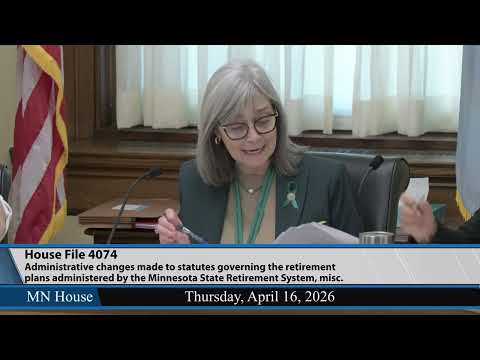
The State Government Finance and Policy Committee adopted Amendment A7 to House File 4074, updating Minnesota State Board of Investment (SBI) billing procedures, and re‑referred HF 4074 to Ways and Means. Four other amendments (A3, A6, A4, A5) were defeated on 7‑7 roll calls amid objections about process transparency.
The State Government Finance and Policy Committee on Thursday moved House File 4074, a pension‑related vehicle bill, to the House Ways and Means Committee after adopting Amendment A7, which modernizes billing procedures for the Minnesota State Board of Investment (SBI).
Representative Lilly, the bill sponsor, told the committee the bill is intended as a vehicle to carry pension commission work and that A7 would “clarify and modernize the Minnesota State Board of Investments billing procedures,” removing a fixed $139,000 appropriation in favor of an expense allocation model across funds SBI manages. She told members that over the past five years investment returns attributed to the state pools totaled about $3,640,000,000 and averaged $727,000,000 per fiscal year.
Jill Schurz, executive director and chief investment officer of the Minnesota State Board of Investment, and SBI general counsel John Mule answered technical questions for the committee. Schurz told members the change would allow SBI to pass through costs for third‑party managers as standard practice. The committee was given an updated estimate for the workload cited in the amendment: “The number is 643,000 per year,” the sponsor reported during discussion.
Amendment A7 was adopted by voice vote with no recorded opposition, after which Representative Lilly moved HF 4074, as amended, to Ways and Means. The committee carried that motion on voice vote.
Several other amendments offered during the same session were subject to roll‑call votes and failed on 7‑7 ties. Those included:
- A3 (cash transaction rounding, commonly called the penny bill, and optional high‑deductible plan language) — tie vote, not adopted. - A6 (prohibiting use of legislators’ office emails or district phone numbers by outside individuals and clarifying penalties) — tie vote, not adopted. - A4 (legislative leave conformity for legislators who also work in the executive branch) — tie vote, not adopted. - A5 (grant summary page) — tie vote, not adopted.
Opponents and proponents framed the debate in procedural and governance terms. Representative Bonner argued that pursuing multiple avenues to enact common‑sense governance bills is routine and urged cooperation to move measures forward. Representative Joy and others objected to what they described as using a vehicle bill to attach measures that are “held up in other committees,” saying the practice reduced committee-level vetting and transparency.
Representative Lilly said her intent was to consolidate related items and move them efficiently to Ways and Means, and that the bill before the committee would receive a delete‑all in later consideration so that the posted amendments would not remain on the pensions bill itself.
The bill now moves to Ways and Means for further action; no final policy changes to pension benefits were adopted in committee during the session covered here.