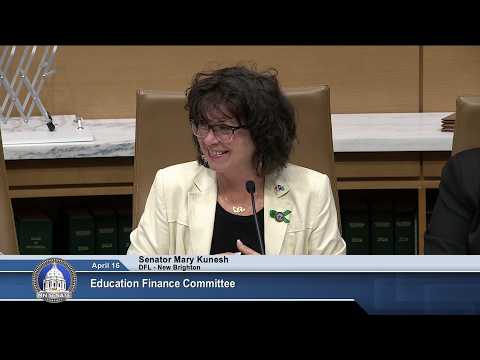
Senate Education Finance Committee advances supplemental education bill after debate over school safety funding
Loading...
Summary
The Minnesota Senate Education Finance Committee on April 16 voted to recommend Senate File 3551, a supplemental omnibus education bill, to the Finance Committee after adopting several technical and programmatic amendments. Lawmakers debated boosting school-safety grants and changes to compensatory aid; a plan to reallocate $100 million to safety failed on a voice vote.
ST. PAUL — The Minnesota Senate Education Finance Committee on April 16 voted to recommend Senate File 3551, the chamber’s supplemental education omnibus bill, to the Finance Committee after adopting multiple amendments addressing school safety, compensatory aid and one-time fund transfers.
The committee’s chair opened the session by framing the bill as a “supplemental budget year” package that focuses on one-time investments to “protect our students,” including anonymous threat-reporting support, strategic hold-harmless funding for schools and targeted grants for special education and facility safety improvements, the chair said.
Why it matters: Lawmakers said limited state resources in a supplemental year make choices difficult but that targeted, one-time aid can address immediate safety and equity needs in K–12 schools. The bill’s passage from the committee advances it to the Senate Finance Committee for further consideration.
What the committee did: The panel adopted several amendments by voice vote, including a technical DE amendment (A4) and the author’s A8 amendment, which clarified items ranging from a Morehead fund transfer and online-instruction language for joint powers and intermediate districts, to enhancements in the Legislative Budget Office’s school group insurance survey, specified reporting changes for the Minnesota Department of Education’s anonymous-threat reporting system and a formula clarification so first-year charter schools’ FY2027 school safety aid is calculated using current-year enrollment counts. The committee also adopted a technical A12 amendment to the school district health insurance report and a compensatory-aid-focused A7 amendment from Sen. Clark that shifts calculations to preserve site-level stability (an updated threshold described in the amendment is 82.3 percent, limiting site reductions to 17.7 percent while keeping a 40 percent building-allocation flexibility). A Maple Lake one-time transfer (A5) also passed.
An unsuccessful push to redirect $100 million: Sen. Rehrig moved the A9 amendment to transfer $100,000,000 from an account that had been intended as a potential federal match for a proposed Minneapolis–Duluth train project into the committee’s school-safety grant pool. "We would go from... $38,300,000... to $90,000,000," Rehrig said, and estimated that, if enacted in that form, each student in the state would receive about "$95.64" for school-safety purposes and schools could access facility grants up to $500,000.
Supporters argued the account is idle and that expanding the safety grant pool would help a wide range of schools. "This is money that's just parked in an account that's never gonna be used, and it can go out to our schools," Sen. Farnsworth said in support.
Opponents raised legal and policy concerns about the transfer and whether the committee had authority to cancel or repurpose the transportation-designated appropriation, and some objected to direct appropriations that would reach nonpublic schools. "We don't have authority over those transportation dollars," the chair said, arguing caution in reallocating funds. Sen. Westland said she likely would vote no because the proposal would continue to provide direct appropriations to nonpublic schools, which she described as problematic.
The A9 amendment was decided by voice vote; the chair announced that the A9 "fails."
Voting and next steps: Following the amendment votes, the chair moved that Senate File 3551 as amended be recommended to pass and be re-referred to the Senate Committee on Finance, with nonpartisan staff directed to make any necessary technical corrections. The committee approved the recommendation by voice vote. The bill now proceeds to the full Finance Committee for further consideration.
Context and committee tone: Throughout the session, senators emphasized the limited nature of supplemental-year dollars and the need to prioritize supports that can be implemented as one-time investments. Several senators also highlighted ongoing work on compensatory aid and pledged continued study and task-force work to refine formula changes.
Notable quotes: "This is a supplemental budget year, and it's a very slim year at that," the chair said in opening remarks. "We would go from... $38,300,000... to $90,000,000," Sen. Rehrig said when describing his A9 proposal to redirect $100 million to school safety. "We don't have authority over those transportation dollars," the chair said in opposition to repurposing the fund.
What’s next: The bill, as amended, was recommended to the Senate Finance Committee. Committee members said further deliberations on compensatory aid and school safety will continue as the legislation moves forward.