Lifetime Citizen Portal Access — AI Briefings, Alerts & Unlimited Follows
OMA says QA lab is progressing through validations; industry presses for clearer recall system and Metrc access
Loading...
Summary
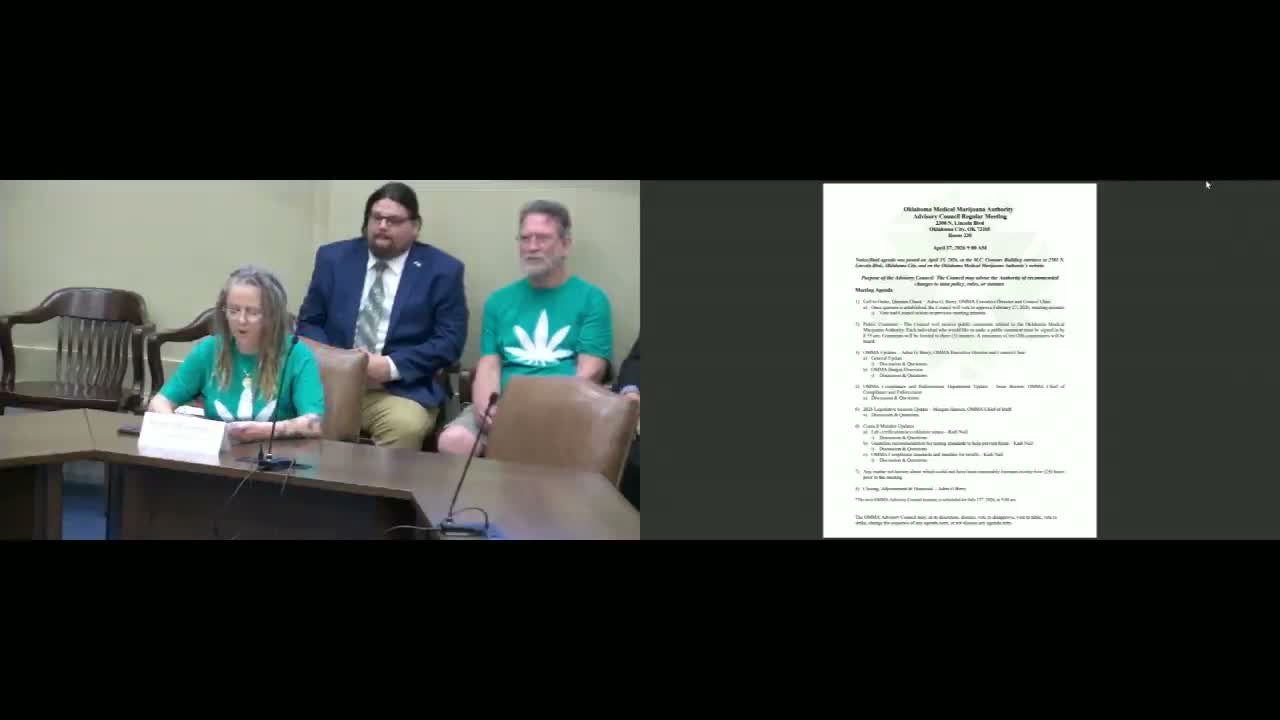
Executive Director Adria Berry told the Executive Advisory Council that the agency's QA lab has completed certain accreditations and is phasing in additional validations, while industry speakers pressed OMA on delayed timelines, THC potency inflation, and the need for a stronger Metrc-linked recall process.
At an Executive Advisory Council meeting, Executive Director Adria Berry said the Oklahoma Medical Marijuana Authority's quality-assurance (QA) lab has completed accreditation steps for certain tests and is moving through staged validations while staff work on public-facing transparency tools.
"OMA, the QA lab is accredited for pesticides in flower and for potency in oils and concentrates as of today," Berry said, and staff expect validations for terpenes, water activity and foreign material to be completed 'within the next couple weeks' and validations for heavy metals, mycotoxins and residual solvents by May, with microbial testing to follow in June. She said ANAB will review the lab in June and return in August to complete remaining validation reviews.
The update came after a series of public comments from industry and patient representatives who said the lab and the agency's recall practices need to be more timely and transparent. Summer Parker told the council the QA lab remains "18 months past the initial 30-day timeline" and asked how many pieces of equipment are installed and ISO-accredited. "A written transcript is not a substitute for a live recording," Parker said, urging more open access to recordings and data.
Several testing-lab speakers described persistent problems they say affect product safety. "We now have a current report that shows a lot of the THC is inflated," said Jeff Havard of Havard Industries, who also raised concerns about terpene inflation and alleged that some contracted labs operate as "de facto" QA testers while remaining under regulatory restrictions for commercial testing. Jeremy Woods of Wild Rose Compliance cited Title 63 and OMA rules on authority-required testing and asked whether failed products were placed on administrative hold or retested.
Berry and Chief of Compliance and Enforcement Jesse Brewer described how recalls and embargoes are handled. Berry said OMA issues public recalls immediately and posts batch numbers and notices on its website, but that placing an administrative physical hold on products invokes legal due-process steps. "We recall it immediately. We just don't push the button that Jeremy is referencing," Berry said, explaining that the agency typically files matters with an administrative law judge to obtain the authority to take possession or to require an inventory hold.
Council members pushed on the practical impact of that model. Council member Katie Nail said she was concerned that email notices and website postings are not sufficient to prevent sales through point-of-sale systems: "If it's not flagged in the system, then it's not gonna go to the POS system," she said, urging OMA to explore Metrc integration or statutory changes that would allow the agency to publish or flag data in the traceability system.
Berry acknowledged a statutory confidentiality limitation on Metrc data enacted in recent years and said OMA uses Metrc internally for investigations. "We have a whole team that pulls metric data and gives us reports monthly," she said, but added the legislature would have to change the law for OMA to publish raw Metrc data publicly.
Brewer reported enforcement metrics covering Feb. 26'Apr. 17: the division processed roughly 2,322 employee credentialing applications, about 290 transporter applications and roughly 276 business license renewals; it completed 779 compliance inspections and advanced 65 administrative actions from 83 investigations. He also said OMA has hired a recall coordinator with FDA experience.
Industry speakers asked about accreditation standards. Havard asked whether the QA lab is pursuing ISO/IEC 17025 and ISO/IEC 17043 accreditations; Berry confirmed the agency is validating methods against those standards and consulting with other states, including Maryland. Berry said the agency terminated a third-party lab contract early when staff found the contractor was not fulfilling its terms and that OMA used the 2024 legislative appropriation to build its own lab.
The council did not take votes; Berry said the agency will post regular updates on a new QA lab web page. The council aims to continue oversight and to discuss potential legislative fixes to streamline recall authority and data access.
The meeting adjourned after scheduling the council's next meeting for July 17 at 9 a.m. in Room 230.