Senate labor committee advances omnibus labor bill after debate over seating, AI rules
Loading...
Summary
The Minnesota Senate Labor Committee voted 6–4 to recommend Senate File 23 73, an omnibus labor finance and policy bill that would restore a historic right to sit for some workers and restrict certain employer uses of AI and electronic monitoring. Lawmakers and business groups clashed over definitions, penalties and enforcement burdens.
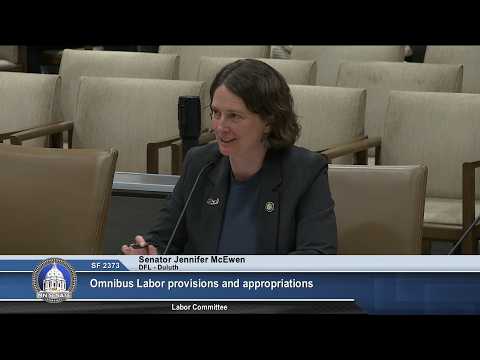
Senator McEwen, chair of the Senate Labor Committee, presented Senate File 23 73 as amended on the committee floor, saying the omnibus measure would fund Department of Labor and Industry priorities, restore a historical right to sit at work, and impose limits on employers’ use of automated decision systems and electronic monitoring.
The bill, McEwen said, would "restore the right to sit in Minnesota law" and prohibit employers from using automated decision systems to infer a worker’s immigration status or protected-class status, require implants or collect facial, gait or emotion data, or surveil workers in private settings.
In testimony, Michelle Mazer of AFSCME Council 5 urged support, saying the seating provision is "a very simple and affordable remedy" that was law in Minnesota for almost a century and that the AI limits provide necessary guardrails against invasive surveillance. "These technologies have made it much easier to scrutinize every aspect of what some of our members do," she said.
Business groups including the Minnesota Chamber of Commerce, the Minnesota Business Partnership and the National Federation of Independent Business in Minnesota opposed the bill’s broadly written requirements. Lauren Schadhorst, director of workplace management and workforce development policy at the Minnesota Chamber, said the bill adds enforcement powers and penalties and contains vague definitions that ‘‘could lead to litigation risks and unnecessarily subject business to penalties.’’ Dalton Danielson of the Minnesota Business Partnership warned that a statutory seating mandate could substitute for job-level professional judgment, and John Beshey of NFIB said expanded job-posting disclosure requirements would create additional cost and complexity for small employers.
Committee members pressed on several technical points. Senator Pappas asked whether the bill’s civil penalty would apply to "each use" of an automated system — a question that prompted lawmakers to scale back the civil penalty. Senator Doornick offered an amendment to reduce a $2,500 civil penalty to $1,000, which the committee adopted. The author also introduced an A19 vendor-disclosure amendment requiring vendors to disclose how algorithms and data are used; that amendment was adopted as well.
Department of Labor and Industry Commissioner Nicole Blissenbach thanked the committee for including several DLI priorities and asked that funding be provided consistent with fiscal notes for provisions that create new obligations for the agency.
Following debate over the scope of AI restrictions, the seating mandate, and an increase of roughly 5.5 FTEs for DLI cited by some members as a concern, the committee moved the bill to the Finance Committee by roll call vote, 6–4. Recorded responses in the roll call were read by the clerk.
The committee discussion showed crosscutting concerns: labor groups framed the bill as restoring worker protections and guarding privacy, while business representatives warned of vague language, enforcement costs and litigation risk. Senators said they expect to continue refining language — especially around automated decision systems and the definition of "each use" — as the bill moves toward finance and, potentially, the Senate floor.