Get Full Government Meeting Transcripts, Videos, & Alerts Forever!
Get email alerts on the Property Tax Proposals topic
No spam. Unsubscribe anytime.
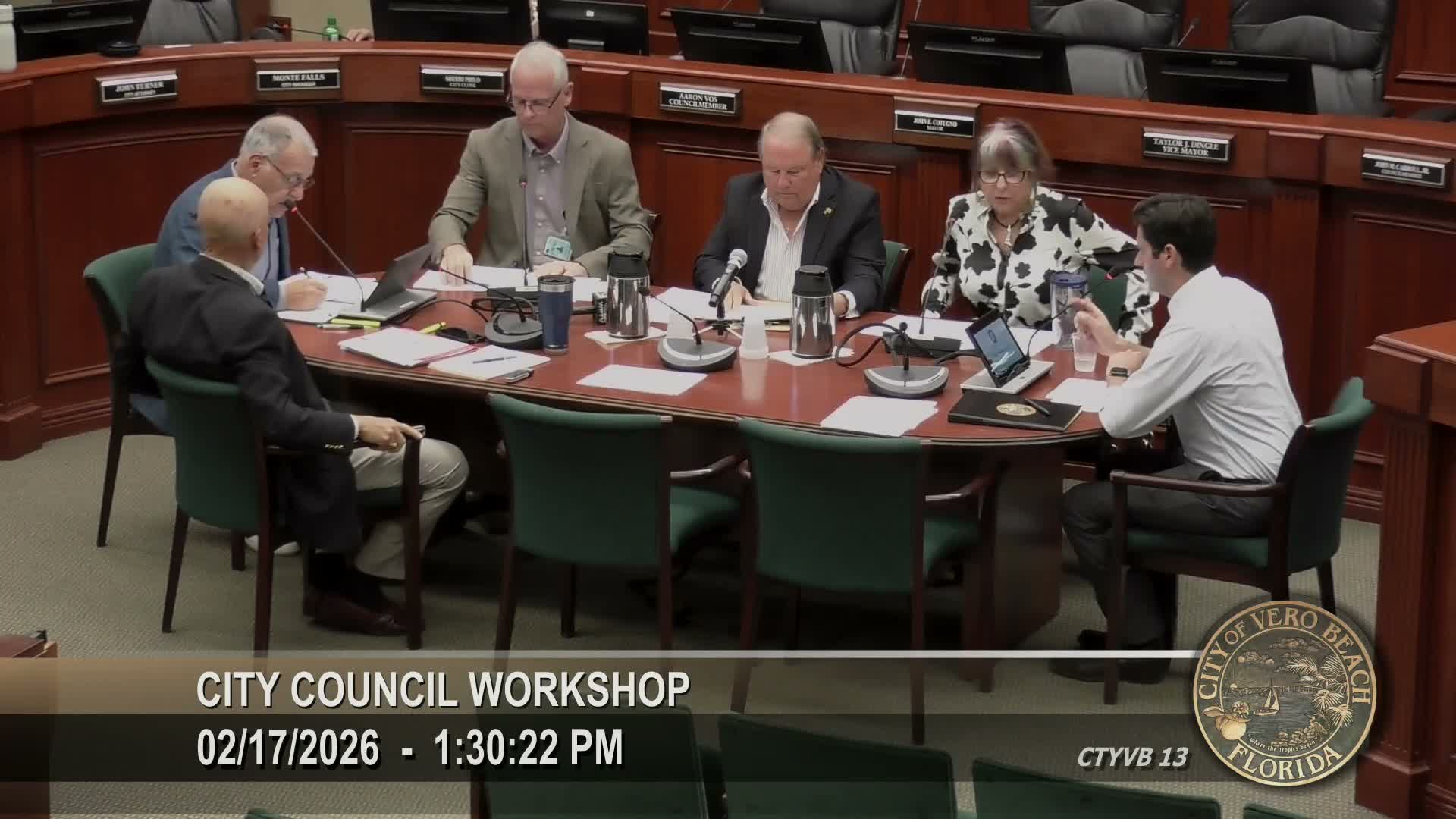
Vero Beach council holds informational session on state proposals to curb property taxes
Summary
City officials and the city manager warned that state proposals to reduce or eliminate local ad valorem property taxes could force cuts to services — from lifeguards to street maintenance — and agreed to add ongoing public-education outreach to future council agendas.
City Manager Monte Monte told the City of Vero Beach City Council and the public that proposed state measures to reduce or eliminate ad valorem property taxes would be a revenue shift, not a straightforward tax cut, and could force steep local service reductions.
Monte said the city’s adopted general fund budget is about $35.95 million and that property taxes comprise about 38.75% — roughly $13.75 million — of that total. He said the police budget is roughly $13.4 million, roughly equal to the city’s property-tax revenue, and warned that proposals to centralize or limit local property tax authority would shift costs into fees or sales taxes and reduce local control over spending priorities.
At a presentation labeled “Property Tax 101,” Monte explained the role of the Florida formulas and protections such as the Save Our Homes constitutional amendment, which caps annual assessment increases for homesteaded properties. He cautioned that eliminating local property taxes would likely benefit seasonal and out-of-state owners while increasing costs for many full-time residents via higher sales taxes, new fees or trimmed services.
A council member who led a PowerPoint walked the dais and the public through modeled scenarios illustrating local exposure: a 10% reduction in property-tax revenue would reduce city receipts by about $1.4 million and could eliminate one to two police positions or equivalent civilian support; a 25% reduction (about $3.5 million) might eliminate four to five positions; a worst-case $7 million loss would force far deeper cuts across departments. Council discussion singled out beach lifeguards (about $1 million annually), free parking, marina fees and deferred street and drainage maintenance as likely early targets for reductions.
Council members and Monte cited League of Cities and county association analyses showing the city receives a relatively small share of total property-tax dollars (about 17¢ of every tax dollar collected, per the presentation) and emphasized that public-safety payroll consumes a large portion of locally available ad valorem revenue. One council speaker reviewed a modeling table, sourced to the tax-appraiser’s office, tied to a draft state measure read in the meeting as “H. J. R. 203” that would phase in $100,000 exemptions and reduce local ad valorem collections in modeled years.
During public comment, resident Kentaig urged an aggressive, nonpartisan education campaign (mailers, short social-media soundbites and templates for contacting state representatives) to explain how centralized decisions in Tallahassee could reduce local services. County resident Patrick Mugen urged legislators be informed that shifting to sales-tax reliance would increase volatility in revenue during economic downturns.
By consensus the council agreed to place ongoing property-tax education and outreach on future agendas and directed the mayor to forward the item to the city clerk for scheduling. No formal vote on policy was taken at the session; the meeting concluded with the council’s commitment to a coordinated public outreach effort.
The city’s materials cited in the presentation include budget figures and an analysis compiled with the Florida League of Cities and the Florida Association of Counties; Monte encouraged residents to direct questions to city staff rather than rely solely on external press reports or social feeds.
What happens next: councilmembers said they will coordinate with neighboring municipalities and legislative contacts to share educational material while remaining mindful of state restrictions on advocacy if a referendum is certified.