House panel advances human services bill after heated debate over Medicaid fraud funding
Loading...
Summary
The House Human Services Finance and Policy Committee amended and re‑referred House File 4338 to Ways and Means after approving a package of program‑integrity and technical changes. Two competing proposals to finance the state Medicaid Fraud Control Unit — a restitution account (A8) and base funding (A9) — failed in separate roll calls amid concerns about federal constraints, accountability and prosecutorial incentives.
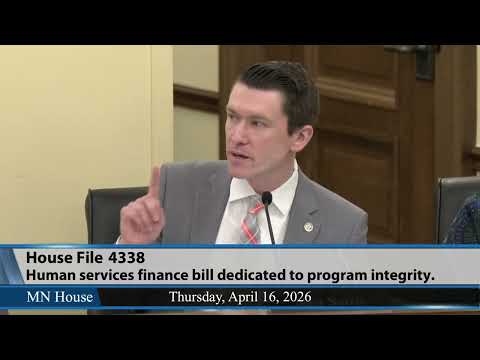
The House Human Services Finance and Policy Committee considered House File 4338 on program integrity and Medicaid‑related policy and adopted a series of amendments before re‑referring the bill to the committee on Ways and Means.
The committee approved a slate of changes — including removing a broad Electronic Visit Verification (EVV) grant of authority to the Department of Human Services (A2), clarifying IHST hour calculations (A4, adopted as amended), adding a moratorium exception process (A13), and several technical fixes — by voice vote. Committee leaders said the package balances program integrity with protecting access to care.
The meeting’s most contentious debates centered on how to fund the state’s Medicaid Fraud Control Unit (MFCU). Representative Backer proposed A8 to create a new “medical assistance fraud restitution account” in the Minnesota special revenue fund to hold recovered funds (court restitution, interest and similar receipts), carry balances across fiscal years, and provide conditional funding to the MFCU or transfers to the general fund depending on account thresholds. Backer said the account would incentivize recovery of fraud proceeds and fund fraud enforcement work.
Representative Norris led a sustained opposition to A8, requesting a roll call and arguing that federal rules and the statutory treatment of recovered funds could prevent the state from using federal Medicaid repayments to pay attorney‑general staff. He warned the amendment could forfeit a federal 3:1 match that amplifies state dollars and could apply unequally to civil recoveries under the False Claims Act. Norris also said the structure risked creating perverse incentives for prosecutors to prioritize restitution checks over criminal accountability: “Our prosecutors should have one goal — pursuing justice,” he said, adding that a funding formula tied to restitution might influence charging or plea decisions.
Backer and other supporters framed A8 as an innovative, market‑style incentive to increase recoveries and argued the account would be a dedicated bucket to track recovered funds. The committee put A8 to a roll‑call vote; the amendment failed, with the roll call recorded at 9 ayes, 8 nays and 1 abstention.
After A8’s defeat, Representative Norris offered A9 to place recurring, base funding in the budget for the MFCU — a request he framed as necessary to hire 18 additional staff (the amendment text and testimony cited 11 investigators and three attorneys among the new positions) and to unlock federal matching funds. Supporters pointed to staffing gaps relative to similarly sized states and the leverage provided by a federal 3:1 match; opponents raised concerns about the Attorney General’s office’s performance and the optics of giving the office additional resources. The A9 amendment also failed on a roll call (8 ayes, 9 nays, 1 excused).
Other adopted changes included A5, aligning state policy with CMS guidance that removed some age‑based limits for home‑and‑community‑based services and creating a temporary moratorium structure for customized living while exceptions are maintained. The committee also adopted an oral tweak to the A4 IHST cap language to read “up to 182 hours per month” to simplify calculations for DHS.
After debate and amendments, the committee adopted the DE1 amendment as amended and voted to re‑refer House File 4338, as amended, to the committee on Ways and Means. Chairs and vice chairs used the closing moments to thank staff and testifiers and to emphasize continued work on long‑term care, program integrity and system modernization.
Votes at a glance - A2 amendment (remove DHS authority for EVV in any service): adopted (voice vote) - A4 amendment as amended (IHST hours phrasing): adopted (voice vote) - A5 (CMS‑related changes and moratorium for customized living): adopted (voice vote) - A8 (create medical assistance fraud restitution account): failed (roll call 9 ayes, 8 nays, 1 abstention) - A9 (base funding for Medicaid Fraud Control Unit): failed (roll call 8 ayes, 9 nays, 1 excused) - DE1 as amended: adopted (voice vote) - House File 4338 as amended: re‑referred to Committee on Ways and Means (voice vote)
What’s next House File 4338, as amended, moves to Ways and Means for further fiscal consideration and potential inclusion in the omnibus budget process. Lawmakers who pressed for more permanent funding for the Medicaid Fraud Control Unit said they will continue to press that case as the bill advances; opponents said accountability and federal compliance remain open concerns.
Sources and attribution Quotes and descriptions in this report are drawn from the committee transcript and roll‑call records. Key speakers quoted or paraphrased include Representative Norris, Representative Backer, Representative Curran and Chair Noor.