Committee debates limits on automated license‑plate reader data and retention
Loading...
Summary
SF 4739 seeks stricter statewide limits on automated license‑plate reader (ALPR) data — narrowing cross‑jurisdictional sharing, shortening routine retention windows and imposing written sharing agreements and reporting; ACLU and law‑enforcement groups both testified, and members flagged retention windows and operational impacts.
Sen. Umu Verbaten presented SF 4739 to update Minnesota’s ALPR statute for modern practice, arguing the combination of expanding private‑sector providers and broad inter‑agency access risks privacy and public‑data compliance. “They are cameras that … capture and store data on license plates,” she said, and the bill would, among other changes, bar sharing ALPR data outside Minnesota except pursuant to a court order or warrant, require written interagency agreements for sharing, and shorten retention for non‑investigative ALPR data to 48 hours to match Minnesota State Patrol policy.
John Bealer, testifying for the ACLU of Minnesota, supported modernizing statute language and public reporting. “The current use and capability of license plate readers far exceeds what was contemplated when the statute was written in 2015,” he said, and described uses nationwide that include immigration enforcement, protest surveillance, and other sensitive applications.
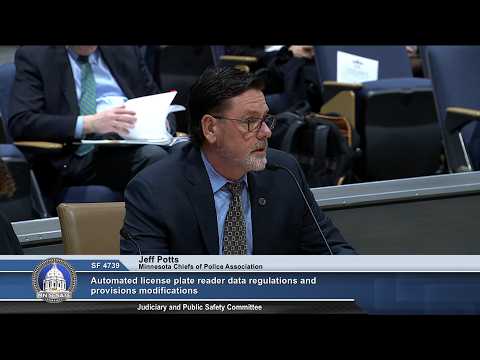
Jeff Potts, executive director of the Minnesota Chiefs of Police Association, cautioned that some provisions would hamper criminal investigations and highlighted two concerns the chiefs raised about the bill as introduced: (1) a centralized repository run by the Bureau of Criminal Apprehension (BCA) (language later removed by amendment) and (2) a reduction in routine retention to 48 hours. “Serious crimes take far longer than 48 hours to investigate,” he said, and provided investigative timelines to argue the shorter retention window might eliminate key leads.
Committee members discussed balancing privacy and public safety. Several members, including Sen. Holmstrom and Sen. Pappas, said they favor stronger safeguards but asked the author to consider extending retention timelines for certain investigations and to ensure interoperability with federal partners in active operations. The author said she would continue stakeholder work and noted some jurisdictions have abandoned ALPRs entirely for privacy concerns; she also emphasized the bill targets non‑investigative retention and requires preservation where data is tied to active investigations.
An author’s amendment removed the provision designating the BCA as a central repository after discussion with law‑enforcement witnesses who raised costs and ownership questions. No final vote was taken; SF 4739 was laid over for further work.