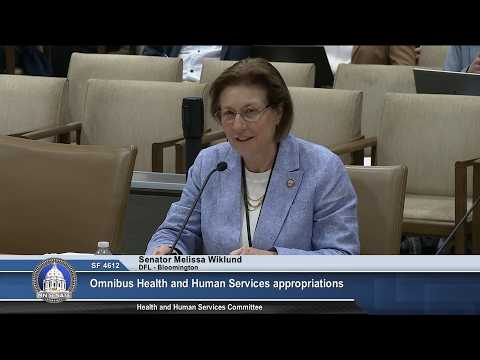
Senate HHS committee advances wide-ranging health bill, including $300 million hospital stabilization package and childcare changes
Loading...
Summary
After hours of amendment debate, the Minnesota Senate Health & Human Services Committee adopted multiple amendments to Senate File 46112 — including a hospital stabilization package, insulin safety‑net changes and several family‑childcare modifications — and voted to refer the bill to Finance.
The Minnesota Senate Health and Human Services Committee on Monday amended and voted to advance Senate File 46112, approving a hospital stabilization package, changes to an insulin safety‑net program and multiple childcare modernization provisions while leaving several technical questions for further work.
The committee adopted A‑17 — the hospital stabilization package — as amended, a multi‑part proposal the sponsor said is intended to shore up safety‑net and rural hospitals facing financial stress. Committee discussion included how to set qualification criteria for recipients and one member’s request to omit a single line that might allow a large nonprofit hospital to qualify; the mover accepted a narrow deletion. After a roll call the A‑17 as amended passed unanimously in committee.
Why it matters: Supporters said state aid can help preserve regional access to emergency, maternal and behavioral health services that are at risk as hospitals restructure. Opponents and cautious members pressed for tighter qualification criteria to ensure funds reach hospitals demonstrably in financial distress rather than large systems with larger endowments.
Key elements and reaction - Funding and scope: Sponsors described the package as a substantial stabilization effort for hospitals statewide; during debate a committee member stated the total shown on spreadsheet materials was $300,000,000. The committee did not amend that overall spending level on the floor of this hearing. - Hennepin Healthcare governance: The committee added A‑24, which creates a governance advisory task force to evaluate structure, ownership models and financing for Hennepin Healthcare and to report recommendations to the Legislature; members discussed membership, the length of the task force and the need for ongoing oversight beyond an initial report. - Insulin safety net (A‑6): The committee adopted A‑6 to modify the insulin safety‑net funding mechanism so the program can draw from an existing repayment account and remove the automatic manufacturer assessment in statute; members debated whether the health care access fund should remain an explicit statutory backstop, with supporters arguing the account will cover routine needs and skeptics warning of potential diversion from Medicaid funding priorities.
Childcare and related provisions The bill’s childcare modernization article drew lengthy discussion and a series of smaller amendments. The committee adopted multiple author amendments that: create a new Class C license option for family childcare with modest capacity changes, shift some variance authority back to counties, remove certain additional training requirements for a subset of Class C license holders (via an oral amendment), and clarify that childcare providers may exercise ordinary parenting choices for their own children provided paid clients are not adversely affected. Several proposed changes — including modifications on overnight caregiver wakefulness and firearm notification wording — were withdrawn for further work.
Other adopted items and process notes - The committee accepted several technical amendments (A‑2, A‑16/A‑25, A‑23, A‑4 and others) that revise definitions, correct cross‑references and rationalize effective dates, often with counsel or department staff explaining the edits. - Multiple testifiers from state agencies and advocacy groups appeared; several authors withdrew amendments after agreeing to continue negotiations with departments or stakeholders.
Quotes and testimony Stefan Guillermoistern of the Minnesota Department of Health described statutory guardrails for the state’s all‑payers claims data, saying the data shared under current law are de‑identified and subject to data‑use agreements and advisory review.
Erica Barnes, executive director of the Minnesota Rare Disease Advisory Council, urged the committee to study reimbursement models for cell and gene therapies, saying for some families “if a child gets these gene therapies, they live; if they do not, they die.” The committee did not adopt the substantive reimbursement language today and the sponsor withdrew the amendment to continue work with DHS.
What’s next The committee voted to pass Senate File 46112 as amended and re‑refer it to the Finance Committee (roll call recorded as 6 yes, 3 no in committee). Sponsors and agency staff said technical cleanups and continued work with departments will continue as the bill proceeds to Finance and floor consideration.
Attribution note: Quotes and specific technical explanations are attributed to speakers who self‑identified in committee testimony or who were introduced by the chair or clerk. Where a figure or claim could not be mapped to a named speaker in the transcript, the report uses neutral phrasing (for example, “a committee member said”).